Showing posts with label maps. Show all posts

Monday, August 29, 2016

Glass Rook Tower & the Astral Spellhold

I'm really happy with the theoretical structure I laid out in this last post, but I needed to see how parts of it would work in practice. So this map right here is basically a rough draft of the glass rooks’ first configuration, the only one that connects directly to the material world. Since it’s configuration 1, the room numbers are presented in a sensible order, but the rest of the configs will be shuffled up as thoroughly as possible.

It’s also my first attempt to depict lateral distance using the same color-coding system I normally use for vertical depth. I think that aspect turned out pretty well.

I must be some kind of idiot, because it didn’t occur to me that the color thing would work until I started sketching things out. I thought it was going to be a standard metroidvania style side-view like the one I did for Peridot,* how dumb is that?

Also, it looks like I forgot to draw stairs between rooms 6 & 7, but I left them out intentionally. You just can’t get to 7 unless you can fly, at least not in this configuration. Or climb I guess but I’d make the walls too smooth and slippery for that to be likely.

Oh and most people reading this have probably seen my posts on G+ and/or Facebook about it, but for those of you who haven’t: I released a pay-what-you-want pdf on DriveThruRPG a week ago called Escape from the Astral Spellhold.

It’s a short, ruleset-neutral trick/trap/puzzle dungeon with a house rule on almost every page and a tiny bit of worldbuilding thrown in for good measure. It’s got clockwork robots, a cranky old wizard, and a completely gratuitous dick monster attached to a Michael Moorcock reference. I think it’s the first time I’ve ever put a dragon in any Dungeons & Dragons adventure I’ve run and it totally ate a dude during the playtest.

Full disclosure: I really just wanted something I could use to showcase my layout skills, but a few people seem to really dig the actual content so there you go.

Download it. Talk about it. Gimme money if you want to and can. If you have a project in the works, and you want it to use functional graphic design that actually improves the game, hit me up.


*this is the one I mean. with the spiral staircase that was apparently designed for people under 3 feet tall. whoops.

Thursday, August 4, 2016

Nested Things

This is a thing that is part of a thing which will eventually be part of another thing. More info on these things to follow.

Wednesday, July 6, 2016

Glass Caves of Carcosa

This is me fucking around with layers and stuff, trying to refine a concept I was playing with a while ago (that Patrick "Maze of the Blue Medusa" "Deep Carbon Observatory" "Fire on the Velvet Horizon" Stuart riffed off of riffed off of on his blog; odds are good that you've already read that post if you're here. if you haven't you should cause it's way better than anything I would have thought of). I wasn't planning on sharing the map originally, so I didn't give the colors much thought as I was drawing it, but now it looks like it belongs under some weird sword & planet setting like Carcosa.


I might extend it in the four cardinal directions in the next few weeks. There's a slight chance I'll get ambitious about it and start illustrating individual chambers. I might never get to any of it. WHO FUCKIN KNOWS NOT ME


Saturday, October 31, 2015

Halloween Dungeon: Candle Cove

This link leads to Candle Cove by Kris Straub, read it if you haven't before, then come right back. It's short, it won't take more than a few minutes. 
I think that story is pretty cool so I based a one page dungeon on it. No monster stats or anything, you can figure those out yourself. I may or may not have ruined the original story, depending on how you look at it. Kris Straub would probably say I fucked it up by explaining too much. To be honest, trying to come up with a motivation for Horace's behavior may have been a step too far. I won't be sad if you to cross that part out.

Sunday, February 22, 2015

Brinewald 1631

Hey Jens I ripped you off again. I made a mini-sandbox, probably good for about 3-4 sessions, in the pocket-mod format (follow the link if you can't figure out how to fold it). The layout's a little cramped but there's a lot there and I'm done fucking with it (for now at least).
Click to biggerize or download the pdf here
I wrote this to use as a sort of prologue for Better Than Any Man, but I think it could easily kick off pretty much any campaign. Just change the last rumor and get rid of the journal and you're good to go.

Saturday, February 14, 2015

More Yoon-Suin

EDIT: Okay so there were some problems with the cover of the print edition but the pdf is on sale now for £6.00 (which google assures me is $9.25).

I have it on reasonably good authority that Yoon-Suin should be released on Monday if nothing stupid happens. It's an OSR style setting with a vague and gloriously misappropriated Tibetan flair. As long as you don't go into it expecting any more historical or cultural accuracy than Forgotten Realms would give you, you're good. It's going to consist (last I heard anyway) of a very evocative Marco Polo stand-in's journal, and all the system-neutral random tables you could possibly need to run a campaign in the setting. Like hundreds of them. Enough that I'm pretty sure any GM who was looking could find something they'd want to use in their own game and setting.

In my last post, I told you that I did the map for it, but didn't mention that it went through a few versions on the way to what you saw in the trailer.


I also never mentioned that I hadn't really done this kind of map before, at least not in public. The image above is from my first stab at it. I kind of liked the weird, abstract mountains (where the yak people live), but it lost all the detail and ended up way too dark when I shrunk it down to the size I needed.


Tea? Semen? Who even knows these days.
I ended up not using these landmark icons because there wouldn't have been
anything to match them visually in the top third of the map.Which kinda sucks
cause I like them but oh well whatcha gonna do.

As you can see, that one was basically just me fucking around with different sorts of mountains. Compare those to the one I eventually ended up going with (sans labels):


The text David gave me to work from went into some detail about what adventurers could expect to find in the northern valleys, so I made a serious effort to emphasize the valleys and ridgelines in that one.


This map of the Yellow City didn't make it into the book, but I think it's pretty cool. The fancier buildings are where the upper crust lives (slug people because fuck you why doesn't your campaign have politically powerful slug people), as you might imagine, and the text really describes a shitload of potential adventures to be had in the ruined areas as well as the dozens of tiny islands to the south (where the crab people live). Oh hey it looks like I scanned that one when it was an early pencil sketch too. Look how big those islands almost were:


Okay that's all I got right now bye.

Sunday, February 8, 2015

Go Big or Get Bent

I decided to redesign my map of the Kellerlabyrinth. The actual thing goes five levels deep in places, but the first time I drew out the dungeon, I left it at three levels because that was already looking pretty complicated.

It took me a couple tries to simplify the deeper version to the point where it’s legible as a one page dungeon, but I think I did alright with it in the end.


There’s a problem though, and if you look at the map a certain way, it’s obvious. Check out this version with most of the outline layers turned off:


The levels are fucking tiny! I do not want tiny levels. My original map had about thirty rooms across three levels, and I only managed to get in about forty on the newer one. The actual Kellerlabyrinth has at least 500 rooms in it.

This problem is also an opportunity to address something else that’s been bothering me. Most of those 500 rooms haven’t been excavated yet. Cave-ins were common, and many rooms and tunnels were sealed off intentionally, but I haven’t accounted for that on the map, which feels like a wasted opportunity. First step is to add a bunch of dead ends caused by collapsing tunnels, but I also want to address what’s beyond them.

My solution is to abandon my initial goal of fitting it on a single page, and stretch it out over five pages, one per level. Like the one above, these still show the colors for the whole dungeon (probably faded way back though, now that I look at it again), but only the outline for one level each. These “highlighted” maps have plenty of extra space for adding rooms with a marker once they're discovered.


I’m thinking about how a procedural system for uncovering new areas and placing them on the map could work, but let’s save that for another post. Obviously, any rules that are intended to generate content on the spot need to extremely streamlined, and that’s gonna take me some time to get right.

Friday, January 2, 2015

I wanna be a Jaguar Knight

I'm trying to do this more often this year. That's not exactly a promise but I resolved to quit smoking like six 12/31's ago and that's still going so let's see how this works out.

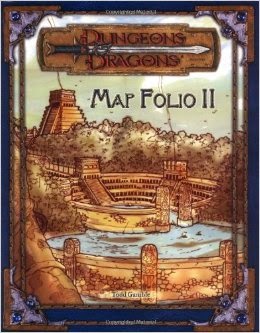
Must have been at least eight years ago, I picked up WOTC’s Map Folio II for some reason. It’s a series of maps that (apparently) originally appeared on their website, and depict a city in the Mesoamerican-based Maztica kingdom. I’ve never used it.

Map Folio II. I loaned it out without taking pictures first.
I showed it to my friend Grant the other day, and he wants to stock it and run it. I told him I’d post some stuff I thought he could use. There’s already these two posts if he hasn’t read them yet, and a lot of really detailed articles at Saurondor.

Grant told me that he’s thinking of this city as a thriving metropolis, which makes stocking it a fundamentally different exercise than if we were talking about a decrepit ruin. The first part of the job, as I see it, is to look closely at what the maps can tell us about the people living there, and the second part is to figure out what the hell to do with that. This is probably going to have to stretch across a few posts. I don’t have the map set in front of me since my friend’s borrowing it, but I’ll see what I can come up with from memory.

The city is a highly planned settlement that looks as if it would probably have been built pretty much all at once, in the shape of a vast amphitheater. The individual maps include a watchtower, a temple, an observatory, a forge or smelter, and a palace, as well as examples of upper, middle,* and lower class neighborhoods. Right off the bat, the forge tells us that this civilization is using technology that real-life Aztecs and Maya didn’t have access to when they were building cities. Similarly, the lower class apartments imply that society has been restructured around this technology. That statement might require some explanation.

Not from the Map Folio.
Look at the Aztec capital of Tenochtitlan. The elite, which consisted of warriors, priests, and royalty, was centrally located, while the rest of the poor schmucks were spread out in blocks of floating gardens that fed the city. In contrast, the city in the map pack has replaced this agrarian economy with an at least semi-industrialized one. Poor folks aren’t spread out and living on the small farms where they work, they’re living in small, tightly packed apartments, presumably because they all work at the same place — the forge.

One way to explain all this is with a brief alternate history exercise. In this version, when European murderhobos like Cortez and Columbus got to the continent, the native kingdoms recognized the apocalyptic danger they were in, and united against them. In real history, Cortez probably would have gotten his heart cut out and thrown onto the sacrificial fire, if he hadn’t formed alliances with the surrounding kingdoms to bolster his tiny and poorly disciplined** invasion force.

If the Spanish conquest fails, then Aztec influence spreads (due to the alliances that kept them alive) and Montezuma II orders that the secrets of steel and black powder are mastered before the next wave of white devils hits the New World, whether by analyzing the equipment of dead conquistadors, interrogating the shit out of the many European captives they’d have taken, or a combination of both. This city was built after that, and is likely the youngest city-state in the empire. It’s most likely to be located at or near a major iron deposit. If that iron deposit was caused by a massive meteorite falling to Earth millions of years ago, then the impact crater explains the shape of the city as a whole.***

So that’s the boring stuff out of the way. This is going to have to be a series. Later posts will be about setting-specific factions and monsters, interesting treasures, and a super-narrow discussion of Mesoamerican religion. Plus anything else I think of.

*This living space also includes shops in front of the apartments, like the tabernae in Trajan’s Market. The general layout of the city was probably pretty closely based on that ancient shopping mall. Do anthropologists know more about how Romans lived than Aztecs, or was there some other reason for the artist to mix the cultures?

Trajan's Market
**The incident that sparked war between the Aztecs and the Spanish (in real history) occurred when Cortez had to leave some of his men in Tenochtitlan under orders to play it fucking cool. As soon as they saw their first human sacrifice, they went totally apeshit and started shooting and stabbing. Also, there was also at least one of his followers (Cristobal de Olid) who, when entrusted with his own command position, went all Colonel Kurtz and tried to set himself up as a king. Cortez himself went to put down the rebellion, but Olid's own men had already done the job.

***Mesoamerican city builders (or at least the Aztecs, Maya, and Inca) were all about reflecting the landscape surrounding a city in its architecture, and allowing the natural and the man-made to coexist harmoniously. I wonder if that’s where Frank Lloyd Wright got the idea. Anyway, many of the Roman-influenced aspects of the city’s plan make more sense if you think of it as being sort of built onto the slopes of a gigantic impact crater.


OH SHIT WHAT ABOUT THE JOESKY TAX

Here's a map of a cenote cave system. If you don't know what that means you really should google it. Maybe I'll decide what's in it tomorrow.


Monday, December 22, 2014

Carcosa: Psychic Cyborg Sorcerer (of Slaughter)

I owe back taxes to Joesky so here is a Carcosa for you.

This adventure is intended for levels one through ten or something like that. There are monsters here that would pummel most level seven parties. That said, I’m pretty sure it’s possible for level one characters to kill everything in this hex if they really apply themselves.

There are two deserts on the map in the Carcosa book. Pick a hex in one of them, and put this stuff there. If you have the book, you know that each hex has two briefly described features. It shouldn’t be too hard to add them in to make this mess even weirder.

Roll random encounter checks (1/6 chance) every 90 minutes in this hex. Descriptions, stats, and reaction tables for the monsters are at the end of this post.
1 2d4 blue people riding mutant protoceratopses (shield lizards)
2 3d6 green people hunting with long spears
3 mutant apex dinosaur (great tooth)
4 psychic cyborg sorcerer of slaughter
5 3d12 wild shield lizards
6 2d4+2 mutant tetrapterix (cliff birds)
7 spawn of shub-niggurath
8 acid bug


TERRAIN
This hex is riddled with the maze-like sandstone cliffs of a technicolor desert. Small clumps of spiny bushes appear every so often, but most have been stripped clean by shield lizards. Every 12 hours, there is a 1/8 chance of a sandstorm picking up that is fierce enough to force the PCs to find shelter or take 1 die of damage per 10-minute round. These storms last 1d8+2 rounds. In addition, PCs must consume double the normal amount of water and food rations due to the harsh climate.

The connections on this node map take three hours to travel on foot (so two encounter checks). Instead of forcing players to map out and navigate some contrived and irritating maze, make them roll an intelligence check to not get lost whenever they try to move from one node to another, unless they’re following a guide. If they fail, they find themselves traveling in circles, traveling for 1d12 10-minute rounds and finding themselves back where they started.

Using a highly detailed map grants advantage to navigation checks. Nothing is stopping the PCs from saying “we take the time to carefully map the canyons as we explore” so that retracing their steps is easier.

ACID BUG CAVE
I would start the PCs off here, where they are railroaded forced to seek shelter from a fierce sandstorm in a deep cave with a tight entrance, too small for any of the local dinosaurs to have gotten into. There is, however, a man-sized acid-spitting centipede living in here, which gets a surprise round unless someone passes an awareness check. The centipede’s acid glands can be harvested to fill 2 standard oil-or-potion sized glass jars.

In the corner of the cave, they find a human looking figure half buried in the sand. If they approach it for a closer look, they see that it’s a long-dead space alien. All that’s left of it is a skeleton and gauntlet (treat as small shield) that has a screen and a switch on the left forearm. If the switch is pressed, the screen activates, pointing the way to the alien’s nearby ship. If anyone can actually read the space aliens’ language, they know exactly what this is. Otherwise they just know it’s a topographical map of the area, centered on their current location, with a blinking beacon to the northwest. The sandstorm dies down after 1d6+2 10-minute turns.

CRATER
The spaceship is located in the middle of a fairly large crater (which is old enough to have some sparse vegetation), and appears to have been badly damaged and partially repaired. The cargo bay door is open. All the interior doors are closed but can be opened with a successful strength check, with advantage if using something like a crowbar. This makes a lot of noise, which will alert the psychic cyborg sorcerer to the PCs’ presence if it’s currently in the ship (a 2/3 chance).


The armory contains six grenades (3 dice of damage) and four high powered laser rifles (2 dice of damage), as well as ten napalm canisters for the cyborg’s flamethrower arm and sixteen power cells for the rifles. The rifles need to be loaded with a power cell to function, and each cell has 50 charges.

In the robotics lab, the PCs find a whole mess of mad scientist style notes, from which they can learn that: 

1) The psychic cyborg sorcerer found a damaged robot in the crashed ship, which he repaired and into which he transplanted his brain. He’s been using the torch and advanced strength of his new body to repair the ship.
2) He knows the conjuration ritual for the Violet Mist, but won’t perform it until he learns the ritual to bind the creature.
3) That binding ritual is inscribed on a tablet that is probably in a serpent-man temple a week’s march away. 
4) That temple is currently inhabited by cannibal bone men that exact tribute (as in people to eat) from all the nearby human groups through force of arms.
5) All of the structural repairs to the ship are complete, at this point it’s just the engine left, which should take about four weeks to fix. The notes are complete enough that only an intelligence check with advantage would be necessary if the PCs wanted to finish fixing it.
6) The sorcerer has a serious grudge against any leader of men you as the DM want, either an original one or any of the ones described in the hex crawl, and would not hesitate to wipe out that man’s entire settlement for the sake of vengeance.

GREEN CAVE
A settlement of 200 green people live in another cave in the cliffs, hiding from the local predators and hunting the smaller dinosaurs. They usually arm themselves with long stone-tipped spears, slings, and stone axes, but their leader and his two lieutenants have acquired red laser pistols (1 die of damage, d100 charges). They aren’t actively at war with the nomadic blues that have set up camp nearby, but they live in a state of mutual distrust. Every week there is a 1/6 chance of the greens performing an elaborate ritual (not the powerful kind that sorcerers perform, more like church) in which they sacrifice a group of 1d12+6 captives to the spawn in the oasis.

There is a completely dark chamber at the back of the caves, the walls of which are covered in cave paintings. The paintings’ subjects include the alien shipwreck as an event, the local dinosaurs interacting with the greens, the spawn of shub-niggurath rising from its lake to accept a blue man sacrifice from green worshippers, and battles between the greens and peoples of various other colors.

Another chamber in the cave system contains dozens of crude candles and well-polished fertility figures carved from precious stone, with a large mat of leaves and feathers covering most of the floor.

BLUE CAMP
The nomadic blue people are a bit more advanced than the nearby greens. They’ve learned to tame the shield lizards and use them as mounts and beasts of burden. Their hunters and war parties are usually armed with short bows and iron axes, wearing leather armor and shields made from deceased shield lizards. Their tents are similarly made from shield-lizard hide and bones. The leader of the blue nomads is armed with a sonic bazooka (3 dice + save or unconscious for 10-30 minutes, 25 charges).

This group of blue men likes to collect hollow objects of all shapes and sizes, and use them as percussive instruments in elaborate drum-circle dance rituals.

Unless something unexpected and probably terrible happens, this small tribe of about 60 will stay in the area for 1d6+3 weeks. Every week, there is a 1/6 chance of all-out war breaking out between the nomadic blues and the cave-dwelling greens.

The connection marked ‘narrow path’ protects them from the nearby apex dinosaur, which would have to squeeze through, making it vulnerable to attack.

LOTUS BUSH
Roll a d6 to determine the color of lotus using the description in Carcosa as a table. There are 2d6 harvestable doses of that here. That’s all. Move along. Well I guess you could be a dick and put a radioactive mutant snake or something in the bush, hiding. Actually yeah do that.
HD: 1/2 AC: as unarmored
Attack: bite (1 die of damage + poison (save to resist) + radiation sickness (save to resist))
Move: 20’

GREAT TOOTH CAVE
There is a large bone pile in the corner of the cave. If the PCs search it, they find a magic chain whip forged by serpentmen among some human bones. It has a ten foot reach and gives its wielder a +6 bonus to any attacks that attempt to disarm or otherwise disable their target rather than cause HP damage. It would have been useful when the serpentmen were capturing humans alive for sacrifice.


CLIFF BIRD NEST
Halfway up the cliff (about 40’ above the ground), there is a very large outcropping covered by clumps of thick, dead bushes and brambles. There are 2d12 cliff birds up here at any given time, as well as 3d4 eggs the size of pineapples.

OASIS
The amphibious spawn of shub-niggurath lives in a large cave hidden near the bottom of this quarter-mile wide and half-mile deep freshwater oasis. Anytime you or anything else approaches the waters’ edge, there’s a 1/12 chance that the spawn will attack.

MONSTERS
Acid Bug - A centipede the size of an adult human, and it spits acid. Sickly white coloring.
HD: 2  |  AC: as chain
Attacks: acid spit (2 dice of damage)
Reactions: ambush (2-12)

Cliff Bird - A brightly feathered tetrapterix-like creature the size of a large dog. They like to climb the cliffs and attack silently from above. Passing an awareness check means you see their shadow and there’s no surprise round.
HD: 1  |  AC: as unarmored 
Attacks: 2 claws (1 die) + beak (1 die)
Move: 40’ land, 250’ air
Reactions: ambush (2-6), stalk and wait for opportunity (7-10), intimidated (11-12)

Great Tooth - Like an allosaurus with a tail like an ankylosaurus and flashy neck frills like the dinosaur that ate Newman in Jurassic Park. About the size of a bus. Always hungry. The PCs can hear it coming from a quarter mile away, but it can also smell them at that distance. It only sees light and movement.
HD: 12  |  AC: as leather
Attacks: charge (8 dice) or gore (2 dice) + bite (2 dice) + tail (1 die)
Move: 80’
Reactions: try to eat you (2-11), brief confusion before trying to eat you(12)


Psychic Cyborg Sorcerer of Slaughter - A ten-foot tall humanoid robot with a thick glass dome at the top of its head, protecting a sorcerer’s undead brain. One of the robots’ arms ends in a human-like hand and the other is mounted with a flamethrower, which also has a setting that converts its napalm fuel into a gas suitable for welding. It’s been using this to repair the dead alien’s spaceship.
HD: 14  |  AC: as full plate
Attacks: incinerate (4 dice) or punch (2 dice)
Move: 30’
Psionics: as 9th level psionic (pgs 18-21)
Reactions: exterminate (2-7), try to recruit you (8-11), lets you go free (12)

Shield Lizard - Like a protoceratops the size of a car, with spikes all around the edge of its face shield and a sharp beak.
HD: 6  |  AC: as leather w/tower shield
Attacks:bite (1 die), charge (4 dice), or trample (6 dice).
Reactions (wild): charge (2-7), ignores you (8-10), curious but tentative (11-12)

Spawn of Shub-Niggurath - About the size of a tenement building, this spawn has a body type basically like that of a fur-covered caterpillar, with four giant bat-like wings that beat with the speed of a hummingbird while it’s flying, two compound eyes, a simple insectoid mouth from which it spits webbing, and a long, whiplike tail.
HD: 10  |  AC: as unarmored
Attacks: tail whip (4 dice) + spit (no damage, target is stuck (save to avoid), strength check or fire (which also burns you) to escape)
Move: 25’ flying, 10’ land, 80’ underwater

Reactions: try to eat you (2-7), not hungry, but webs you out of spite (8-10), ignores you (11-12)

Thursday, October 23, 2014

Dungeon map: Kellerlabyrinth

The Kellerlabyrinth is a maze of tunnels under the streets of Oppenheim, Germany. They were constructed according to need (as opposed to following some overall architectural scheme) over the course of at least six hundred years. I first read about it in this blog post.

I was working on a 30 Years War sandbox around that time, which made me even more excited than I should have been about Better Than Any Man when it came out a couple months later. The story's main town of Karlstadt is fictional, but another location on the map isn't: Wurzburg, which, by LotFP rules, is only a three days' walk (unencumbered) from Oppenheim. So this would actually make a pretty good follow up if any of my players ever manage to live through BTAM (seriously none of them even know about the Insect Cult).


This map doesn't even come close to depicting the entire tunnel system, which apparently could have more than 600 rooms in it. Most haven't been discovered yet because tunnels have collapsed or been intentionally blocked off, so you can think of this as one of the undiscovered sections. Some areas go five or six levels deep, but I think this is just enough visual complexity to not be overwhelming.

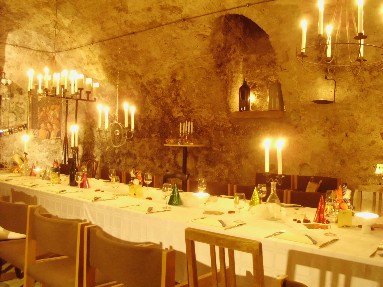
The side bar on the right is just general guidelines to use when stocking it, but I ran out of space. There also would have been plenty of grafitti (most people were at least literate enough to sign their own names by this point), and probably drinking halls like this modern one set up:
How many historical attractions have bars built right in? (okay probably a lot actually but shut up)
I wouldn't be at all surprised to find a few fingers of the worm hiding in the bottom level. The worm could even be intentionally fueling the madness of the 30 Years War, the witch hunts, or even the whole worldwide General Crisis (a.k.a. the reason LotFP is set in the seventeenth century by default).

Thursday, October 16, 2014

Overland Map 1

More playing around in Procreate. Just a small, generic barony/duchy/whatever. I'm pretty sure the icons are obvious, except possibly the village represented by little boxes surrounding the keep. The mine cart was less vague before I zoomed back out but I still think it reads.

I'm already juggling a couple campaign settings, so I doubt I'll do much with this anytime soon. If you find a use for it (or anything else I put up here really), let me know. No labels because 1) you can use it for whatever this way and 2) naming things is more boring than drawing them.