Showing posts with label kellerlabyrinth. Show all posts

Sunday, February 7, 2016

Quick DMG to the 30 Years War

The 30 Years War was a big complicated mess, in a way that makes it uniquely gameable. It was part of what historians refer to as Europe’s General Crisis, a century-long period of violent political and religious upheaval combined with famine and plague.

It is in no way necessary for a DM to understand all the details of the 17th century political landscape in central Europe in order to run a good game in that setting (although if you happen to enjoy studying history, it certainly wouldn’t hurt), but there are a few major points that could potentially be useful to know when you're coming up with encounters, or when your players start doing things you don't expect.

So here's a quick list of simplified gameables for DMs who haven't got the time or inclination to look into the history themselves. Anyone else probably knows all this. If anyone else is you, feel free to add good stuff I left out in the comments.
  • “Germany” did not yet exist as a coherent nation, and wouldn’t for a couple more centuries. Instead, the region was dominated by what was known as the Holy Roman Empire, a loosely-stitched together group of states each ruled by semi-autonomous electoral princes. By the time of the 30 Years War, many of these princes were Protestants, while the imperial dynasty was fiercely Catholic. The war was initially fought between an alliance of rebel princes and those loyal to the empire and if that doesn't sound familiar why are you even reading this?
  • The violence of the General Crisis was, if not caused by, then at least enabled and encouraged by the intra-religious conflict that began a century earlier with the Protestant Reformation. The most basic way of viewing these wars, including the 30 Years War, was as a conflict between Catholics and Protestants (mainly Lutherans but Calvinism was starting to catch on too). This is the underlying conflict that a lot of that time & place’s jingoistic propaganda exploited.
  • Religious oppression largely took the form of witch trials and inquisitions. Accused heretics were being executed at a faster rate than any other time in European history. So in a game with magic users, they generally would not have been trying to advertise. Bizarre wizard's towers could still exist, obviously. The setting just gives you a good opportunity to use weird magic to hide them really absurdly well.
  • What began as a civil war was kept going by opportunistic and expansionist foreign nations getting involved. In 1631, when Better Than Any Man is set, King Gustavus Adolphus’ Swedish troops were sweeping through Germany. Their standard tactics were more appropriate to the technology of the time than the tactics of their rivals were, and they earned a reputation as an unstoppable horde. Each victory added territory to his relatively tiny empire.
  • Aside from the continent-wide religious conflict of the day, the largest rivalry in Europe at the time was between two of its richest, most powerful families: the Bourbons in France and the Hapsburgs in both Spain and the Holy Roman Empire. Both the Hapsburgs and the Bourbons were Catholic, but the kingdom of France was squeezed between the Spanish and the Germans. This led to the Bourbons aligning themselves with the mostly-Protestant enemies of the Hapsburgs, further complicating any answer to the question “just what were these whackos fighting over, anyway?” This gives a DM multiple factions and somewhat tenuous alliances to play with.
  • Soldiers were not well paid (or fed) in this time & place. It was common practice for rulers to blow their savings raising armies from a combination of foreign mercenaries and their own peasantry, then leave them to provide for themselves by “living off the land” (raping-pillaging-killing their way across the countryside). This led to a serious enmity between peasants and soldiers, regardless of sides or religious preference. There was always a wide "foraging" area around the actual armies, creating twin crises of famine and internally displaced refugees. Which made conditions ideal for the spread of the bubonic plague.
  • The belief that these were the End Times was not at all unusual. The Four Horsemen of the Apocalypse (War, Famine, Pestilence, and Death) were considered by many to be the most powerful forces in Europe. This was sometimes metaphorical but often meant in a quite literal sense, especially among the uneducated peasantry, who really couldn’t be expected to grasp the bigger picture of what was happening to them. My point here is that no urban encounter table in this setting would really be complete without at least one or two doomsayers. A secondary point is that things like the physical incarnations of the Horsemen are always fun to stat up.
  • This is one of those wars where the safest place to be, by far, was in the army. At least that way you had a weapon, maybe even some light armor if you’d plundered enough to afford some, and a group of other armed men that (barring extraordinary circumstances or personal grudges) had your back. The second safest place to be was in the cities and larger towns, because the worst of the pillaging happened in out of the way farms and villages. Which meant that many towns near passing armies were overrun with refugees, while others would have turned them away for fear of the plague.
  • The fact that being in the army was somewhat safer than any alternative didn’t stop countless soldiers from deserting and becoming outlaws or switching sides. The punishment for desertion was hanging, but only if your own side managed to catch you, and they were usually too busy to try hunting you down. On top of that, mercenary units were often officially disbanded, penniless, armed and thousands of miles from home, putting them in basically the same position as the deserters. The major takeaway for a DM here is there were small groups of outlaws all over the damn place.
  • If you don't know anything about the period at all, firearms existed but were just being introduced. They took forever to reload and malfunctions could be disastrous and they really weren't all that much more useful than swords at that point.

Friday, November 6, 2015

Nice Streets Above

I’m just about done writing and laying out my Kellerlabyrinth project, which I’m calling Nice Streets Above, after a song by Wire. The song is an expression of rage generated by upper class pricks. The title is relevant to the adventure both in that sense, and in a purely literal one, as the tunnels beneath the streets are inhabited by refugees and the human parasites. It’s a dungeon and a slum at the same time, and several conspiracies with unique goals and methods are based there.

I can see no reason why horror, science fiction, superhero fiction and fantasy shouldn’t all be the same thing, and NSA reflects that aesthetic. There’s also a little bit of history, which is basically horror anyway. The supers influence shows in some of the choices that PCs may find themselves faced with; the abilities they might gain, and the prices that must be paid.

I’m designing this to be played with any edition or retroclone of D&D. NSA is set in the tunnels under Oppenheim during the 30 Years War, so that ruleset is the most obvious fit. It would also be really easy to fit this and Better Than Any Man into the same campaign. I’m not including many stats in NSA though, so it shouldn’t be too hard to convert to whatever RPG rules you prefer. One of these days I wanna try running it with FASERIP and probably also one of the Dr. Who RPGs.

I figured out what to print on the back cover as a teaser. It’s super pretentious and I’m not fucking changing it. Imagine it being read to you by that movie announcer guy:

A war over a decade old.
A city under foreign occupation.
A refugee crisis with no end in sight.
A rebellion brewing beneath the streets.
A privileged society abusing mystic abilities.
A cult of the hopeless and their gods of decay.

Welcome to Oppenheim.
Corruption is power.

And here’s a couple of illustrations, from a page of potentially recurring NPCs. One set of three basically normal humans, and one set of weirdos with secret powers.


It would be pretty funny if repeating the acronym NSA over and over got me put on a watch list of some sort.

Tuesday, September 29, 2015

Roll All The Dice Generators (as opposed to tables)

I made these largely to create more white space in the Kellerlabyrinth room descriptions, hopefully encouraging DMs to add stuff and make the dungeon their own. The goal is to randomize all the necessary (but generic) elements in a way that still produces variety and even occasional surprises for the PCs.

At least a few of the generators are appropriate for general use with OSR systems. I'm assuming ascending armor class because that's what I use. If you prefer descending AC, change the (+10)s to (10-)s & the (+12) to a (7-) and you should be fine.

Most of these are pretty closely based on one of the die-drop tables in Vornheim. I love the immediacy of those things, but they take up too much room on my tiny and already cluttered gaming table. This is my solution for people who think die-drop tables are peachy keen but can't fit them on their D&D tables.

Fighter
d4 1-cutlass 2-war axe 3-morningstar 4-halberd
d6 (+12) armor class. on a 1 or less, has a barbarian-like rage ability
d8 hit points per level. on a 1, has a musket
d10 level
d12 morale*
d20 silver pieces

*For the other two classed NPC generators, I have morale attached to level. Separating it for the fighter sort of implies that fighters are more likely than the other two classes to be crazy bastards who think they're invincible. A low-level fighter with 12 morale is probably a zealot of some sort, but that's up to whoever's running it. Not sure if I'm keeping it that way yet, but I like it in theory.

Magic-User
d4 hit points per level
d6 1-trickster 2-blast mage 3-druid 4-necromancer 5-oracle 6-cleric
d8 (+10) armor class
d10 level. also morale
d12 on a 1, has a blunderbuss
d20 silver pieces

Specialist
d4 1-smoke bomb 2-poison 3-haste potion 4-trap kit (already set up)
d6 hit points per level
d8 (+10) armor class
d10 level. also morale
d12 on a 1, has a pistol
d20 silver pieces

Private Guards
d4 hit dice (+8=hit points, combat bonus)
d6 (+10) armor class
d8 (+4) morale
d10 1-hammer 2-halberd 3-cutlass 4-axe 5-flail 6-cestus 7-morningstar 8-bolas 9-whip 10-mace
d12 number of guards
d20 sp between them

Cathouse, Gambling Hall, Tavern or Opium Den
(roll separately for guards)
d4 (-1) Usual Suspects** present
d6 (-1) employees (other than owner and guards)
d8 door quality (subtract from lockpick and bashing attempts)
d10 drinks for one gp
d12 revelers present
d20 (x4) gp value in
(mostly cp and sp)

**What I've been calling a list of 12 NPCs with (what I hope are) interesting hooks for the players. I'm not gonna post the list right now but if you're reading this, you're probably deep enough into the hobby to come up with your own NPCs (or find some online) if you need to.

Storeroom
d4 lock quality (subtract from lockpicking attempts)
d6 door quality (subtract from bashing attempts)
d8 on a 1, dead drop with a secret message
d10 on a 4 or less, the door is trapped
d12 (x5) sp of low-value household goods 
d20 gp of luxury items

Waste Room
(it takes at least 10 min of searching and a saving throw against plague to find anything)
d4 on a 1, this is a nest of vermin. If the room is bricked up, they’ve dug out some escape routes. If there’s a mold patch, they’ve been eating it and mutating.
d6 on a 1, a dead body
d8 on a 1, larval mold patch
d10 on a 4 or less, the room is full to the waist and the doors are bricked up
d12 on a 1, a living human baby. If there is also a vermin nest, the baby is currently being chewed on and bawling its eyes out (audible outside the room).
d20 cp scattered about

Vermin Nest
d4 1-rats 2-mosquitos 3-spiders 4-bats
d6 (/2) number of mutants (if fungus is present)
d8 hit dice per swarm
d10 morale
d12 (/3) number of swarms

d20 sp worth of shiny trinkets

Refugee Camp
d4 elderly present
d6 adults present
d8 children present
d10 on a 1, a pet bear
d12 on a 1, a crotchety old fart with a blunderbuss
d20 sp worth of valuables between them

Thugs’ Hideout
(all these numbers added up equals how much in sp they charge refugee camps for "protection” per week)
d4 enforcers present (2 HD)
d6 (+3) HD of leader
d8 on an 8, one of the thugs is a mad bomber
d10 on a 10, 1 war dog (2 HD) for every 2 thugs
d12 thugs present (1 HD)
d20 (x5) gp value of hoard

Tuesday, August 11, 2015

You snorted my brother. Prepare to die.

The Oppenheim Kellerlabyrinth is haunted by the ghosts of four Catholic saints, known collectively as the Four Holy Marshals. The Knights Templar had their remains moved to the tunnels centuries ago, to contain a then-recently discovered infestation of hyperdimensional fungoid aliens. The order currently has no information on just where these demons came from, they only know that this threat to their world must be contained at all costs.

Several intelligent fungoid species inhabit the lowest levels of the kellerlabyrinth. Although their adult body types and abilities vary greatly, all of these species go through a roughly similar life cycle, which has three stages: embryonic, larval, and mature. All three stages, if harvested and consumed properly, have potion-like effects on the user. The corpses of mature molds yield a great deal more doses than the embryonic and larval

They periodically produce reproductive spores, which are released into the air and immediately abandoned by the parent. Spores that randomly find themselves in ideal environments (damp, cool, presence of nutrition, etc) continue to reproduce, forming into molds that produce temporary effects in most animal species (including humans) when consumed. 

Embryonic Mold: Potion-Like Effects
orange mold: size doubled (+4 to damage rolls, +2d6 temporary HP,  -4 AC penalty)
grey mold: healing (must be applied directly to wound)
blue mold: visions (must be smoked; there’s a secret society that's sprung up around this substance but that’s a whole other post)
red mold: double movement and number of attacks (must be dried, powdered, and snorted)
purple mold: etherealness (must be consumed as a tea, can walk through walls, +4 AC bonus, clothes and equipment also become ethereal)

There’s a weird old lady that lives in the kellerlabyrinth and sells potions, powders, etc. distilled from these embryonic molds. She knows more about these creatures than anyone except the Four Holy Marshals, but is a little crazy and any hints she lets slip will be cryptic in nature. She’s also been experimenting with the combining of molds to produce new effects, to varying degrees of success.

The inquisitor hates her and wants her to burn, but she makes clever use of her potions and keeps making a fool of him every time he tries to fuck with her.

Whenever one of these embryonic molds grows to a sufficient size, it begins to develop specialized structures with similar functions to those of our brains and sensory organs. Molds at this stage are capable of producing weaponized spores, but not reproductive ones. These spores are the only natural defense of molds in this larval stage. Larval molds are completely immobile, but have achieved basic sentience and are constantly learning during this period.

Larval Molds: Weaponized Spores
(PCs get a chance to roll an appropriate saving throw for all these effects. Obviously.)
orange mold: size increases beyond the size of the room, bones start getting crushed
grey mold: out-of-control permanent constitution-draining tumors 
blue mold: confusion and/or suggestion
red mold: possibly fatal heart attack, survivors are still incapacitated for 1d6 rounds
purple mold: PC (but not clothes or equipment) becomes completely ethereal and floats up to the surface over the course of 3 rounds per dungeon level between the PC and the open air.

If PCs find an embryonic mold to be useful and keep returning to its location to harvest more, there is a 1/6 chance for each day it’s been since the room was last visited (maximum of 5/6) of the mold having advanced to the larval stage.

Once these fungoid neural structures have been completed, the molds begin to focus on producing limbs (1d6-2 trunk-like legs, 1d8-1 tentacles, minimum 0, roll again on a result of no limbs). Within a few days, these limbs are usually large and strong enough to be useful to the mold, and the creature is considered mature. Molds with legs can walk around and perform slam attacks, and ones that have tentacles can use them to manipulate objects as well as grabbing and constricting enemies.

All mature molds can produce the same weaponized spores as their larval forms at will, as well as empathic spores which allow a basic form of universal communication, and reproductive spores (produced involuntarily whenever the adult mold consumes enough extra nutrition). They also have intrinsic, always-on abilities that correspond to the effects of consuming each mold type in its embryonic form.

I'm writing this for low level characters, so it makes sense to me that these creatures should have about the same stats that whatever game you're playing uses for let’s say a cave bear (aside from the unusual limbs and spores and intrinsic qualities). If your party averages around level seven or higher, you should probably think about upping the hit dice (but you hopefully know that by now if you've been running a campaign that long).

Mature Molds: Intrinsic Qualities
orange mold: size doubled, +4 HD, -2 AC penalty
grey mold: regenerates 1d4 hp/round
blue mold: can see a second into the future like a jedi (+6 AC)
red mold: double movement speed and number of attacks
purple mold: ethereal (can’t be physically harmed by non-ethereal creatures or objects, but can attack others and walk through walls) 

They don’t have anything resembling an animal’s mouth, but it takes about twelve hours to completely grow around an adult human corpse, digest it, and eject perfectly clean bones. Mature molds need to consume more than four adult humans (or an equivalent amount of non-human animal meat) to produce reproductive spores.


This means that if a mature mold causes a Total Party Kill, and the replacement characters find their way back to that room, it will probably still be full of bones, and partially covered in mold colonies in their potion-like embryonic stage.

Sunday, February 8, 2015

Go Big or Get Bent

I decided to redesign my map of the Kellerlabyrinth. The actual thing goes five levels deep in places, but the first time I drew out the dungeon, I left it at three levels because that was already looking pretty complicated.

It took me a couple tries to simplify the deeper version to the point where it’s legible as a one page dungeon, but I think I did alright with it in the end.


There’s a problem though, and if you look at the map a certain way, it’s obvious. Check out this version with most of the outline layers turned off:


The levels are fucking tiny! I do not want tiny levels. My original map had about thirty rooms across three levels, and I only managed to get in about forty on the newer one. The actual Kellerlabyrinth has at least 500 rooms in it.

This problem is also an opportunity to address something else that’s been bothering me. Most of those 500 rooms haven’t been excavated yet. Cave-ins were common, and many rooms and tunnels were sealed off intentionally, but I haven’t accounted for that on the map, which feels like a wasted opportunity. First step is to add a bunch of dead ends caused by collapsing tunnels, but I also want to address what’s beyond them.

My solution is to abandon my initial goal of fitting it on a single page, and stretch it out over five pages, one per level. Like the one above, these still show the colors for the whole dungeon (probably faded way back though, now that I look at it again), but only the outline for one level each. These “highlighted” maps have plenty of extra space for adding rooms with a marker once they're discovered.


I’m thinking about how a procedural system for uncovering new areas and placing them on the map could work, but let’s save that for another post. Obviously, any rules that are intended to generate content on the spot need to extremely streamlined, and that’s gonna take me some time to get right.

Sunday, February 1, 2015

Oppenheim Rumors

I felt like screwing around with the Kellerlabyrinth some more. These are some rumors you may hear in the city above it.

1 Not everyone is willing to put up with Catholic rule. There’s a group that meets deep in the kellerlabyrinth, each week, on the eve of the sabbath.
 There’s been an outbreak of the plague. We must seek out the witch and cut this evil off at its source, before she spreads it further!
3 You know, some of the older cellars don’t even belong to anyone anymore; just locked up loot, and no one’s got the key. 
4 Keep away from the Den of the Dragon, if you value your eternal souls! That wicked old easterner Zheng’s been leading our children into temptation too long.
5 My niece went down into the kellerlabyrinth, and never came out. Last week, someone said he saw a giant spider wearing her dress!
I met a man who fought the Swedes up north in Breitenfeld (September 1631). He said they will never be stopped.
7 The kellerlabyrinth is a hive of sin and heresy, crawling with witches and hideous abominations. Stay in the Lord’s sunlight, where the dangers are at least familiar. 
8 I hear the inquisitors are offering a reward of 30 pieces of silver for information leading to the capture of a practitioner of witchcraft.
9 I saw a rat the size of a pony down in the tunnels the other day! You won’t catch me down there again.
10 I hear that a group of women has dared to usurp control of a town near Wurzburg. It’s not right, I tell you. Someone needs to remind them of a woman’s place. (referring to Better Than Any Man, the most elaborate Free RPG Day release I’ve ever seen. Download the pdf version here.)
11 All the dog owners I know have had their hounds go missing in the past couple weeks.
12 The booze must be starting to get to me. I swear I saw an eyeball crawling around in here on little pink legs earlier. I’ll definitely quit drinking tomorrow. ::belch::
13 The Hapsburgs have commandeered at least a half dozen cellars to store their munitions. Good thing it’s too damp down there for a fire to start accidentally.
14 I was robbed on the road, my friend — by the devil himself, I tell you! He wore a green suit and a blood-red cloak.
15 My cousin said she saw a Roman officer in the tunnels. Apparently he made as if to remove his helmet with both hands, but the whole head came off with it. She swears it winked at her before fading away.
16 See that guy with a hook for a hand over there? He claims to have explored more of the kellerlabyrinth than anyone alive.
17 The old beggar, Whiskey Pyotr, swears up and down that he seen a wolf, big as a horse, running through the streets of Oppenheim. My pa says it was the whiskey what seen it. 
18 I have a friend who works for the Spanish, and he says that a prominent servant of the Hapsburgs is secretly working with protestant dissidents.
19 Eduardo Hapsburg has just arrived in town. Word is he’s looking for someone specific.
20 I saw two men in grey robes pay a couple of thugs, the identity of whom may or may not be known to me, for three tightly wrapped bundles. Why yes, I would say the bundles were about corpse sized. How much gold did you say you have on you?

Sunday, October 26, 2014

Kellerlabyrinth Keyed (basically)

Decided to partially stock my Kellerlabyrinth segment. "Partially" because this is one of those partly-ruined/partly-still-in-use dungeons where it makes sense to try and get across a largely abandoned feeling.

First, some history to give this stuff some context. According to the adventure background in Better Than Any Man, it takes place in October 1631. Wurzburg falls to the Swedish on October 15.

Before the war started, Oppenheim was under the jurisdiction of the (protestant) Count Palatine. The Spanish Hapsburgs (in an alliance with the Austrian Hapsburgs a.k.a. the Holy Roman Empire) took the city in 1620. The (protestant) Swedish army took Oppenheim on November 7 on its way from Wurzburg to Mainz; 23 days after the Bishop of Wurzburg surrendered.

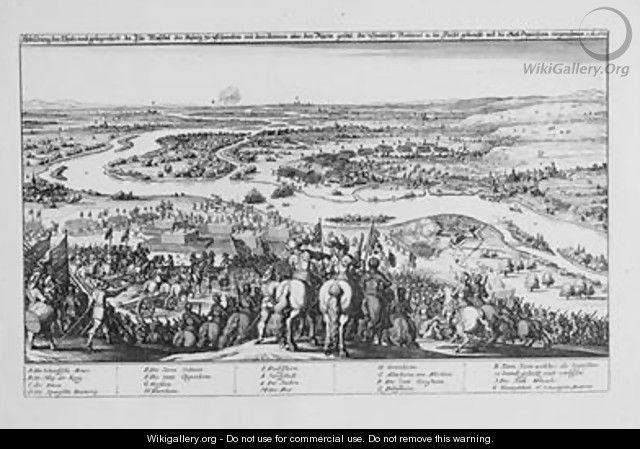
While the Spanish had control of the city, they were using it to store weapons and ammo, and for access to an important bridge, which in turn gave them access to the entire Palatinate. In the image below, the six-pointed star shape next to the river is the wall surrounding Oppenheim. Those blocky shapes to the left of it are probably Swedish mixed unit formations of musketeers and pikeman (the taller, lighter blocks are pikes being held at shoulder arms). Don't ask me where the bridge is; it might be too small to see in the distance if it's right by the city but I really couldn't say for sure.
Artist: Matthaus the Elder Marien
So, to summarize from the DM's point of view: the campaign begins with BTAM at the beginning of October 1631. Wurzburg falls on October 15. The trip to Oppenheim* takes between a day and a half and a week, depending on how much crap the PCs are lugging around and whether or not they've managed to steal some horses. Assuming they arrive by November 7, the (catholic) Spanish are in control of the city until then. Some of the occupiers will be preparing to offer token resistance, while others will be taking their troops and heading north to Mainz, where the real siege is gonna go down.

After November 7, the (protestant) Swedes are in charge. The changes that matter to PCs will mostly be cosmetic (government officials have Swedish or German names instead of Spanish ones), but protestant civilians will be likely to start treating them like heroes if they helped liberate the city in a significant way.

*Yeah okay this part is totally railroading the game if you aren't prepared to improvise a little, so here's the obvious disclaimer: The PCs are of course free to keep fucking around near Wurzburg and Karlstadt or go wander around Germany or whatever, but tell the players that there's cool stuff under Oppenheim and maybe they won't be lame about it. If they do get distracted or something, there's nothing wrong with taking elements of this and putting them elsewhere; I'm assuming you've done this before if you are going to try and run this adventure location, so you probably know what to do.

I haven't assigned these encounters to any particular spot on the map so just number the rooms however you want. Assume that any humans without hit dice or levels listed are untrained peasants.


1) Munitions Storage
Door: Medium quality lock on a wrought iron gate. 2 3HD Spanish Soldiers are posted outside, wearing morions and breastplates, armed with pikes and flintlock pistols.
Contents: Full of weapons. If you want pistols, muskets, pikes, swords, shot, or gunpowder, this is the place to get it. I'm not worried about how much stuff there is to take away because I generally keep track of time and encumbrance; even if they make multiple trips, the PCs won't run out of stuff to cart off before the next guard shift shows up. Let's say there's enough in here to arm one unit (regiment I think? I'm not up to speed on 17th century military jargon) each of musketmen, pikemen, and cavalry.

2) The Meeting Place
Door: Medium quality lock. If there is a meeting underway,
Occupants: If there's no meeting happening, there's no one here. Assuming the meeting is in progress, there are 6 Mysterious Figures in the room, wearing identical hooded cloaks that hide all identifying features. They know the Swedes are on their way, and have developed a plan to blow up several Hapsburg weapon caches, but lack the skills to pull it off. One or two are wealthy merchants that can afford to pay the PCs pretty well. If the PCs don't accept this mission, the resistance finds someone else, so the Swedish attack is still successful. If the PCs kill the resistance members, there's no good reason there wouldn't be more spies the PCs don't know about.

3) Jaspar's Treasure Cache
Door: Heavy oak door, high quality lock, poison needle trap triggered by attempting to pick the lock. Attempting to force the door has a 1/4 chance of causing the tunnel to collapse (in addition to the usual wandering monster check). There are two keys to this door; one belongs to an officer named Jaspar Hardtman and the other belongs to his manservant, Symon Dreyer.
Contents: 6 chests containing 230 gp, 1250 sp, and assorted gems and jewelry worth 150 sp.

4) Cursed Statue
Door: Heavy oak door, high quality lock, poison needle trap triggered by attempting to pick the lock. Attempting to force the door has a 1/4 chance of causing the tunnel to collapse (in addition to the usual wandering monster check). The key belongs to someone but I'm not saying who.
Contents: A fine layer of dust over everything, an old desk with a leather-bound journal describing a merchant's expeditions to the Indian Subcontinent and a map showing the location of Petra (stumbled upon while fleeing Bedouin raiders on a return trip), a painted ebony statue of Kali the Destroyer that comes to life and fucks you right the fuck up if you enter without using the key. Not bothering with stats here; let's just say I don't expect the party to live if they try to fight. If they do beat it, the statue crumbles; the resulting pile of debris takes up 10 inventory slots and is worth around 80 sp.

5) Kruper's Hideout
Occupants: Velten Kruper, a level 4 mage, armed with a flail. Erbrechen (translation: the act of vomiting), Kruper's disgusting little homunculus familiar, unarmed but his bite causes (on a failed save) uncontrollable nausea that lasts 1d4 rounds AND it does 1 point of temporary CON damage that heals when the victim eats a meal and rests. Kruper is either asleep or tinkering with his equipment or spellbook, which contains 4 level one spells and 3 level two spells, in addition to one custom spell:
Crawling Eye (Level 1): At the end of the incantation, the caster pops out one of his or her eyeballs, along with several inches of optic nerve, and tosses it to the ground. The optic nerve splits into three legs and becomes mobile. The eye is controlled (and transmits information) through direct psychic contact, which doesn't distract the magic user from whatever else he's trying to do (although anything involving depth perception should be rolled at a disadvantage). The eye can move as quickly as an unencumbered human, is extremely sneaky and hard to hit due to its size, and has one hit point. If your eye is destroyed, you don't get it back (One-Eyed Velten has a nice ring to it now that I think about it). If you lose both eyes you basically have to invent and translate your spellbook into braille if you want to ever use it again.

Contents: Bed, foot locker with a change of clothes and some rations, table & chair, alchemy equipment, box of candles, silver candelabra worth 50 sp, leather purse containing 80 sp.

6) Refugee Camp
Occupants: 1d6+4 Peasants, 1d4 of whom are children. The refugees are shaken down for what little they can scrape together on a weekly basis by Bardthold's gang.
Contents: Straw mats, sacks containing basic goods, a couple farming implements that could be used as weapons in a pinch, torches in holders.

7) Bardthold's Hideout
Occupants: Barthold Vischer, level 5 fighter with a scarred left cheek, wields a 10' long hooked chain that can be used to attack, trip, disarm, or grapple, ring mail armor, iron key, wineskin. 2 2HD Bodyguards, leather armor, pike, 1d30 sp each, no morale failure. 3d6 1HD Thugs, club or dagger, 1d12 cp each.
Contents: two dozen straw mats and blankets, locked chest containing 3500 cp, 350 sp, and a silver locket with a broken chain, containing the portrait of a young officer, worth 20 sp to a merchant or 300 sp to his mistress, torches in holders.

8) Guarded Cache
Occupants: 1 2HD Veteran and  2 1HD Guards, leather armor, shortswords, shields, writ of employment, 1d12 sp each. 2 2HD Wardogs.
Contents: Three straw mats, two iron-bound chests with very high quality locks. One is trapped with a glass vial of poison gas that expands to fill the room, and the other contains 650 sp and 320 gp.

9) Rat's Nest
Occupants: 1d4+2 1HD Giant Rats, Rat Swarm.
Contents: rat feces, broken and rotted crates full of spoiled goods, a weird orange mold that the rats have been eating.

10) Locked Storeroom
Door: Average quality lock, reinforced with wrought iron bands. The key belongs either to Olga Bruns in room 15, or to one of the surface innkeepers.
Contents: 6 kegs of beer, 3 casks of wine, crates full of pickled vegetables and salted meats wrapped in wax paper.

11) Forgotten Storeroom
Door: Old, faded wood, high quality lock, rusted and brittle hinges.
Contents: Thick layer of dust over everything. A bunch of old, broken junk, and a child-sized skeleton locked in a cage in the corner. The skull has a third eye socket in the middle of its forehead.

12) Shrine to The Four Holy Marshals
Contents: Wooden altar, wooden statues of four saints (one against each wall), with the name of the subject conveniently carved into each base. All five objects have been down here in the damp air for around a hundred years and are partially covered in grey moss (useful for healing potions).

13) Plague Quarantine
Occupants: 1d4+7 plague victims. Sister Anneke Everding is tending them, which she sees as a holy sacrifice as she is sure to become infected soon.

14) Opium Den
Occupants: Zheng Wulian, the face of the operation, level 3 rogue, extremely gifted with languages, armed with two flintlock pistols and a sword, wearing a large emerald ring4 3HD Guards, barechested and scarred veterans that came here from China with Zheng, each armed with two maces and a dagger. 1d8 Semi-Conscious Peasants. 1/4 chance of a Usual Suspect.**
Contents: A dozen cheap, straw-stuffed mattresses, 4 long-stemmed ivory pipes carved like oriental dragons, a locked wooden chest containing 2000 cp and 500 sp, a large brass urn containing let's say a pound of opium, 4 large brass lamps in the arabic style.

15) Drinking Hall
Occupants: Olga Bruns, runs the place. 1d8 Peasants1d2+1 1HD Thugs1d4-1 Usual Suspects.**
Contents: Puddle of vomit, tables, benches, tin mugs, 4 large kegs of beer and 2 large casks of wine in an alcove, iron chandelier, box of candles, chest containing 450 cp and 80 sp.

Okay so the map I drew has about twice as many rooms as I've detailed here. You can stock the rest with the following table, using the details in similar rooms that I've already described as a guide:
1) Refugee Camp
2) Waste Room (full of filth and garbage, will eventually be sealed off)
3) Locked Storeroom
4) Munitions Storage
5) Looted Storeroom
6) Looted Storeroom
7) Forgotten Storeroom
8) Forgotten Storeroom

Random Encounters
1) Rat Swarm, 1/4 chance that they are plague carriers.
2) A Black Cat, that is almost certainly a transformed witch, crosses your path.
3) 1d6+1 Wild Dogs, if there are three or less present then they have rabies.
4) 1d4+2 1HP Giant Centipedes, about a foot long, paralytic bite.
5) 1d6+2 Thugs, clubs and knives, 1d12 cp each.
6) Velten Kruper's Crawling Eye.
7) A Usual Suspect.**
8) Plague Victim, has gone mad and escaped the quarantine.
9) Ghost of St. Quirin
10) Ghost of St. Hubert
11) Ghost of St. Cornelius
12) Ghost of St. Antony
All four of the ghosts have the power to bless or curse PCs (maybe I'll do the specific effects in a later post but this is already way longer than I thought it would be). They are all-knowing within the confines of the Kellerlabyrinth, and decide what to do with you based on your actions on what they see as their turf.

**Usual Suspects 
1) Hernando Perez, inquisitor, level 3 fighter, suspects everyone including PCs of witchcraft, will pay handsomely for magic users or information leading to their capture, armed with a flintlock pistol, a rapier, and a stiletto.
2) Sly Ludolf, hustler, level 4 rogue,  prefers three card monte so get practicing, DM. Or if you are an irretrievable klutz, he uses loaded dice (before the game, pick a couple and melt them VERY slightly in your oven with the number you want most often facing up). A leather purse contains 2d30 cp. Carries a rusted shortsword.
3) Hermann Clump, ratcatcher, talks to them, is friends with them, is defensive of them, can summon a swarm of them to protect him in combat, eats them (they don't mind because they have tiny easily manipulated rat brains). Keeps a couple rats hidden in his clothing when in public areas. They tend to run around in there, which is inconvenient, because Hermann is a bit ticklish. Armed with a big-ass meat cleaver that counts as a battle axe. Treasure: cheese, moldy cheese that makes you either hallucinate or completely understand the universe (it's impossible to tell which for sure).
4) Ilsabei Muller, super protective mother, never seen without her 8 year old son, Erich. The second time you meet this pair, Erich's eyes have grown noticeably darker, and his voice and mannerisms have changed in an ominous sort of way. Ilsabei hasn't noticed, and even if you point it out to her, she's likely to chalk it up to puberty. If you point out that Erich is probably a bit young for that, she'll claim this is due to his "exceptional qualities." There will be no reasoning. They're both unarmed but who the hell knows what Erich's capable of.
5) Maren Domeier, musician, carries a mandolin, only plays her own songs. These are somewhat nonsensical ditties about life in the tunnels, which occasionally yield useful information to any careful listeners in the audience.
6) Masked Woman, no one else seems to be taking any notice of her, but she's staring at you and she hasn't blinked once. Her sword and cloak look just as expensive as her ceramic mask, which is shaped like a stylized owl.

Thursday, October 23, 2014

Dungeon map: Kellerlabyrinth

The Kellerlabyrinth is a maze of tunnels under the streets of Oppenheim, Germany. They were constructed according to need (as opposed to following some overall architectural scheme) over the course of at least six hundred years. I first read about it in this blog post.

I was working on a 30 Years War sandbox around that time, which made me even more excited than I should have been about Better Than Any Man when it came out a couple months later. The story's main town of Karlstadt is fictional, but another location on the map isn't: Wurzburg, which, by LotFP rules, is only a three days' walk (unencumbered) from Oppenheim. So this would actually make a pretty good follow up if any of my players ever manage to live through BTAM (seriously none of them even know about the Insect Cult).


This map doesn't even come close to depicting the entire tunnel system, which apparently could have more than 600 rooms in it. Most haven't been discovered yet because tunnels have collapsed or been intentionally blocked off, so you can think of this as one of the undiscovered sections. Some areas go five or six levels deep, but I think this is just enough visual complexity to not be overwhelming.

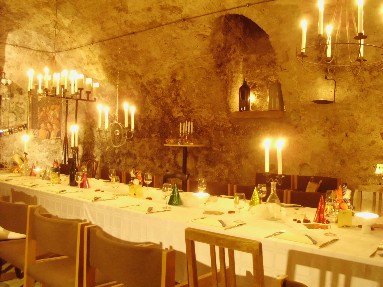
The side bar on the right is just general guidelines to use when stocking it, but I ran out of space. There also would have been plenty of grafitti (most people were at least literate enough to sign their own names by this point), and probably drinking halls like this modern one set up:
How many historical attractions have bars built right in? (okay probably a lot actually but shut up)
I wouldn't be at all surprised to find a few fingers of the worm hiding in the bottom level. The worm could even be intentionally fueling the madness of the 30 Years War, the witch hunts, or even the whole worldwide General Crisis (a.k.a. the reason LotFP is set in the seventeenth century by default).