Showing posts with label mesoamerican. Show all posts

Saturday, April 25, 2015

Birds, bats, bees, pteranodons. Two spells.

This post will eventually have something to do with RPGs. Probably.

To the best of our knowledge, true flight has only evolved a few times on Earth. Bats, birds, now-extinct pterosaurs, and flying insects have all filled similar evolutionary niches, and it's likely they all got there in similar ways.

We understand the evolution of birds the best of those four groups (or at least think we do), due to well-documented fossil evidence uncovered in the 20th century. Tiny cousins of Velociraptor started climbing trees and ambushing whatever walked underneath. The ones who could jump farther from their hiding spots were less likely to starve and more likely to reproduce, so scales gradually grew into longer and softer feathers that produced a gliding effect. All the climbing made forelimbs longer and stronger, until they became capable of making the transition to true wings.

Bats followed a similar evolutionary pattern, starting with a tiny tree-dwelling mammal, and making the transition from climber, to glider, to flier. A minority of biologists believes, based on similarities in the brain structure of Megachiroptera (flying foxes) to that found in primates (and no other mammals), that these giant fruit bats might be more closely related to us than to the brown bats we have throughout North America. It's a bit of an odd hypothesis, but if it turned out to be true, it would mean that the traits necessary for flight evolved twice within the class mammalia, through an identical series of adaptations, arriving at close to the same result. These separate lineages would also explain why Megachiroptera are the only bats that don't use echolocation.

Flying squirrels aren't closely related to bats, but could they be on their way to becoming bats?

Pterosaurs presumably evolved from tiny lizards under similar environmental pressures, but paleontologists can't come to an agreement on which tiny lizards they evolved from.

The first animals to master flight on this planet were the arthropods that would later become flying insects. Insect wings were once thought to have developed from gills like those found in mayflies, but a general consensus is forming that the first flying insects descended from the trees in a similar progression to those of birds and bats.

Flying squirrels aren't the only animals currently at the gliding stage of this process. Flying snakes are well documented in the rainforests of Southeast Asia, (where the tallest trees are less densely packed than the ones in South America, an environment which seems to favor prehensile tails and other climbing adaptations over gliding adaptations) and have the ability to flatten themselves by sucking in their abdomens and spreading out their ribs, allowing them to slither absurd distances through the sky like flexible, elongated frisbees. They're able to produce lift and even change direction slightly, in a way that the Department of Defense is spending money to try and understand. If their descendants ever work out how to turn around in mid-air, actual flying vipers will suddenly be a thing. Their scales may even soften and elongate like theropod scales did, eventually becoming feathers.

I want to know how obvious the ability to fly would be to a biologist looking at a flying snake's bones. I want to know if this adaptation once existed elsewhere, among other snake species in similar environments, and paleontologists just haven't caught on yet. I want to know if there was a time when the tree canopy in South and Central America was much thinner than it is today. I want to know if ancient Olmecs were used to looking up to watch feathered serpents trace strange paths through the sky.

Archaeologists don't agree on how important the feathered serpent concept was to the Olmecs. The Mayan version, a deity known as Kukulkan to the Yucatec Maya and as Q'uq'umatz to the K'iche Maya, doesn't appear to have reached its eventual level of importance until the Post-Classic era. The Aztecs called it Quetzalcoatl, this time one of the three or four most important beings in their religion.

Think about a telephone game that goes on for more than two thousand years, starting with sightings of what looks a lot like a mysterious kingdom of magic flying snakes (which are eventually outcompeted by their much larger climbing cousins and go extinct). Written language exists for at least part of that history, but knowledge is tightly controlled and mystified by the religious class.

At some point, other serpent deities showed up. All of them could fly. Vision serpents were said to dwell in the topmost branches of the Maya version of the world tree, and acted as conduits between the physical world and the spirit realms. Lots of Maya rituals involved getting the attention of vision serpents by bleeding all over specially prepared paper, which was then burnt. The bleeding man or woman (probably experiencing drug and endorphin induced hallucinations) would then watch the smoke from the offering form a serpent, and either a god or an ancestor would pop his or her head out of its mouth to tell the bleeder something crucially important.

There's also the fire serpents, or Xiuhcouatl. The Aztecs saw them partly as weapons of Huitzilopochtli, their patron god of war and the sun. Fire serpents were also revered by Post-Classic Maya warrior cults, who also depicted them as weapons of the sun. Two really obvious ways to use fire serpents in a D&D game would be to reskin salamanders as Xiuhcouatl and/or the spell meteor swarm as rain of serpents or something like that.

My JOESKY TAX is a pair of spells or rituals related to vision serpents:

Call Vision Serpent (Level 1)
This ritual is performed whenever some needs to contact the dead or divine for advice in some dilemma or other. The spellcaster prepares a pile of papers with arcane diagrams and secret names, as well as the name of the spirit or deity being summoned. Whoever wishes to commune with the spirits must offer up the majority of their blood, allowing themselves to be drugged, and then piercing and cutting themselves in the most painful ways availabl, allowing their blood to pour onto the papers. The visionary must save or die from blood loss during this process (okay if you wanna be a big softy about it, drop 1d20 from their maximum HP instead; this still might kill them or nerf them forever, but this ritual isn't meant to be performed lightly). Even if this save succeeds, the bloodletting process reduces the character's current HP to 1.

The papers are gathered into a bowl when it looks like the visionary is getting ready to pass out from blood loss (and drugs), and lit. The plume of smoke takes the shape of a serpent, visible only to the recipient. The serpent, having fed on the blood of the recipient, calls forth the spirit or deity that was specifically asked for. This entity will patiently listen to the dilemma of the vision's recipient, then respond in one of the following ways (referee's choice or random):
>the entity will share the location of an object or NPC that will be crucial in solving the problem.
>the entity will reveal hidden information about what's going on behind the scenes.
>the entity will directly advise the recipient to make a particular decision (usually good advice).
>the entity will reveal one or more secret weaknesses in the recipient's enemy.
>the entity will angrily accuse the recipient of wasting their time, and vanish without helping at all. This only happens if the entity feels it is being called upon to address something below its station (a king to settle a gambling debt) or outside of its divine portfolio.

Serpent Road (Level 1)
Spellcasters are also able to convince the vision serpent to act as a planar gateway for the subject of a nearly identical ritual, though a fresh human heart from a willing donor must be added to the sacrifice. Assuming the aspiring planar traveller makes their save during the bloodletting, they are devoured by the serpent, which appears to them as a vast smoke-walled tunnel. To observers, a plume of smoke appears to completely envelop the traveller and then disappear, taking the traveler with it. The serpent then spits out the traveler (along with any possessions being carried) in whichever supernatural realm was named in the blood-soaked ritual papers. The subject will be weakened (1 HP) and somewhat disoriented from the ritual, but the experience is sobering enough that the character won't be too high to function.

This ritual is a two-way ticket, and the vision serpent will facilitate the subject's return as soon as some condition, predetermined by the spellcaster preparing the ritual papers, is met. It's worth noting that the diagrams and names on the papers are incredibly complicated, and that it would generally be pretty easy for the the spellcaster to lie to the traveller about either the destination or the return condition.

The spell can also be used to provide simultaneous travel for a group, by providing one sacrificial heart for each traveller. All group members must perform the bloodletting portion of the ritual, including the saving throw and HP loss.

Sunday, March 15, 2015

Mesoamerican Bestiary Part Two

Part one way back here.

Okay so there’s a type of contemporary folk monster in Latin America collectively called the duende, sort of a gremlin or goblin equivalent.* Depending on who you ask, this creature may or may not be the same thing as an Alux (plural: aluxob), which is a Nahuatl word for something really close to the same gremlin archetype.

The thing is that duende legends originated in Spain and Portugal before the conquistadors brought them over to the new world. So there’s a couple possible implications. The traditional (read: eurocentric and insulting) way of seeing it is to assume that the Maya and Aztecs adopted the belief from the Spanish, and applied their own Nahual language to it. The other is to assume that the Alux legends existed before the Spanish arrived, that the only reason we don’t have explicit records of that particular belief is that the priests and conquistadors burnt all but three of the many codices they found, and that the creatures are just similar enough in temperament for their names to be used interchangeably in a modern context. If this is the case, the Aluxob were a sort of mischievous nature spirit or elemental.

Another folktale I’ve tied into that of the duende is that of La Lorona, or the Weeping Woman. The legend goes that she drowned her children for the love of a man, who then rejected her. Crushed, she committed suicide. When she reached the gates of the afterlife, she was asked where her children were, and turned away until she could find them. Now, she is cursed to walk between this life and the next as an undead spirit, sometimes compared to a banshee, hunting and stealing the children of others in a futile attempt to replace her own.

Some say that this legend is based on a Nahual woman named Malinal and known to the Spanish as La Maliche, who served Cortez as a translator and advisor during his conquest of Mexico. The most important factor that made this conquest possible (among many, including gunpowder and rudimentary chemical warfare), was a divide & conquer strategy that pitted multiple native factions against each other to multiply Cortez’s invasion force. Sort of like smart PCs in a super-traditional D&D campaign.

This means that Malinal (La Lorona) would have played an invaluable role in the deaths of her people and culture (her children). In fact, the Aztecs referred to her and Cortez by the compound title of Malintzin, since he spoke through her. She’s also thought to have been Cortez’s lover, having borne him a child, before he rejected her in favor of a Spanish noblewoman. Now here’s the part where I tie in the duende: Malinal hunts Europeans (especially the Spanish) and transforms them into duende that follow her unconditionally (the children La Lorona kidnaps for her own).

SO:

La Lorona
She appears as a beautiful native woman dressed completely in white, always crying loudly when encountered. Those not of native descent who hear her wailing must save or are irresistibly compelled to follow her to her Shadow Kingdom (something like Faerie but with skulls and rivers of blood all over the place), where they are transformed into her children, the duende, over the course of a day.
HP:22 | CB:+10 | DM:2 attacks for d12 | AC:0 | MV:20’ | MO:12 | ethereal

(These stat lines are for my house rules, which is homebrewed to the point of being a different game. If you want to use this monster with old-school D&D rules, then use the CB as the monster’s hit dice, and AC here is on an ascending scale from 0 (no armor) to 7 (plate armor with helm) and doesn’t include any sort of dodge bonus. DM = damage, MV = movement, MO = morale, and all of those can pretty much stay where they are. Or just use the stats for a banshee and goblins.)

Duende
These creatures are about as tall as a human child, with somewhat adult proportions. The major exceptions are overly large & pointed ears, and long, crooked noses. They are thieving bastards that must eat humans to survive, preferably children. 
HP:2 | CB:1 | DM:d6 | AC:0 or 2 (leather) | MV:30’ | MO:5 | stealth

Alux
The aluxob are only a couple of feet tall, and wear traditional Mayan dress. They come into being when native farmers build a house for one, known as a kahtal alux, which looks a lot like a miniature step pyramid that comes up to about shoulder height. For seven years, the alux watches over the farm and guarantees a good harvest. At the end of this period, the farmer must seal off the kahtal alux, or it goes feral.
It builds its own kahtal alux at the entrance of a cenote or wet cave and begins playing potentially deadly tricks on humans. They have the abilities to become invisible at will, and to spread disease by touch. Use whatever disease rules you prefer; personally I like the disease rules in LotFP. Incubation period one day, interval of four hours, infection time two days total, save or -1d4 constitution at each interval. Let’s say the main symptom is projectile rainbow vomit.
Aside from a generally mischievous sense of humor, their primary motivation is a kinship with and desire to protect nature.
HP:2 | CB:1 | DM:d6 | AC:0 | MV:30’ | MO:7 | invisibility, disease

Tlahuelpuchi
Some natives are unknowingly cursed from birth to become tlahuelpocmimi (for real I don’t understand Nahuatl pluralization rules at all you guys) around the time they reach puberty (like X-Men!). These creatures have the ability to separate their bodies at the waist, storing their legs in a safe place, and transforming their upper bodies into faintly glowing vultures. They also must drink the blood of at least one human per month to survive, and prefer to prey on children.
In order to enter a potential victim’s house, the tlahuelpuchi must first fly over it in a cross pattern, north to south and east to west.
If one of these living vampires is ever found out, the monster must be killed on the spot. However, if a family member of the tlahuelpuchi causes its death, the curse is passed onto that relative, so families of the tlahuelpuchi hardly ever alert their neighbors to its presence. These parasites also have an ancient bargain with shamans for their protection, but what the shamans get out of the deal is unknown.
HP:8 | CB:6 | DM:d8 | AC:1 | MV:50’ | MO:5

Cadejo
There are two cadejos, one black as coal and one white as chalk. Both have the appearance of wolves about the size of horses, with horns and hooves like a goat, and brightly glowing, red eyes. They only appear between the hours of midnight and one in the morning, and are primarily concerned with protecting drunks, adventurers, and other degenerates. The black one protects men, while the white cadejo protects women. Sometimes this means they end up fighting each other, which is obvious when you think about it for like two seconds.
HP:15 | CB:6 | DM:d8 horns, d8 bite, or d12 trample | AC:3 | MV:60’ | MO:11


*Not a D&D or Tolkein style goblin, a spoken word folktale style goblin. Which is basically what most of us probably think of as a gremlin. I am being redundant.

Friday, January 23, 2015

Mesoamerican Bestiary Part One

A few ideas for Mesoamerican themed D&D monsters and how to use them. I’m including stats for my house game so Grant can use them. If you want to convert these to standard OSR-type games, you can use the CB value as the creature’s hit dice, and AC here is on an ascending scale from 0 (no armor) to 7 (plate armor with helm). DM (damage), MV (movement per combat round) and MO (morale) can all stay as they are. Everything on this list can see in the dark.

Warrior Statue
This abstracted statue of a fierce warrior will come to life and attack as soon as a specific condition, determined at the time of its creation, is met. Some ancient sorcerer-kings have been known to create entire armies of these eternal guardians to stand watch in front of their tombs. Their eyes are usually made of either polished obsidian or other valuable stones.

gnome-sized- HP:6 | CB:1 | DM:d6 | AC:7 | MV:10’ | MO:12
human-sized- HP:10 | CB:3 | DM:d10 | AC:7 | MV:20’ | MO:12
ogre-sized- HP:14 | CB:4 | DM:d12 | AC:7 | MV:30’ | MO:12

Avatar Statue
Normally, the deities don’t care much about mortal affairs as long as they get their sacrifices. In times of desperation, a deity may temporarily channel a small portion of its power into a statue or carving depicting that deity, bringing the monolith to life. Or at least that’s what the high priests say happens. Maybe it's just them enchanting the statues themselves like the guardian statues.

In addition to the combat abilities of a warrior statue, each avatar statue has the ability to cast the spells within that deity’s domains.

Obviously if you're only going to have one avatar statue in your whole campaign it has to be a statue of Coatlicue or you suck.

Tezactelotl
Gorilla-sized jaguar-like creatures every bit as intelligent as humans, but lacking the hands required to build and use tools. They prefer to eat humans/humanoids whenever possible, out of spite rather than because of a flavor preference. They also like to play with their food. Tezactelotls speak Nahuatl in a creepy whisper like Edward Norton as Batman (EDIT: fuck you Edward Norton and Christian Bale are basically the same person), as well as their own language composed of deep growls and other cat noises.

Tezactelotli prefer to dwell in ruined human settlements, or in cave systems that are similar in their complexity. They are also more social than their less intelligent cousins, living in prides with 3d12 members.

HP:12 | CB:4 (adv to stealth & perception) | DM:d10 claws | AC:2 | MV:80’ | MO:8
Spell-like Abilities (1/day): phantasm, charm person, fear, aid of earth.

Mizquixolotl
Giant, moving trees from an alternate reality in which all intelligent animal life was exterminated long ago. Right now, they’re only studying humanoid cultures, but they’ve got a big xenophobic streak and it wouldn’t take them much to go full-on genocidal again.

Mizquixolotli have a rich culture that is unknown to most humans, in which music, sculpture, horticulture and magic are all facets of the same mathematical discipline. They control the growth of trees and smaller foliage in at least seven dimensions, causing branches to apparently grow into each other or suddenly appear out of nowhere when viewed from a certain angle. The aesthetic quality of these works is determined both by their visual form and the surprisingly complex tones and beats made by wind passing through their leaves and branches. 

Both the unearthly music and the hyperdimensional forms of the trees contribute to bizarre magical effects. These include multisensory illusions, imperceptible teleport traps, gateways to other realities, time dilation bubbles, and all kinds of crazy shit.

HP:24 | CB:6 | DM:d10 | AC:4 | MV:30’ | MO:10

Lemisch
A mostly aquatic canine the size of a pony, with a serpent like tail twice as long as its body. It lairs in freshwater caves, and lies in wait near the surface for prey. These predators are only found alone or in breeding pairs.

HP:14 | CB:3 | DM:2 claws (d6) or tail slap (d8) | AC:3 | MV:30’ land 60’ water | MO:7
If a tail slap hits, the lemisch grabs on and begins to constrict next round, 1d8 per round, check to escape each round.

Hueke-Hueke
Possibly a sub-species of stingray that somehow evolved amphibious qualities, as well as powerful claws at the end of its fins. Hueke-hueke don’t move quickly on land, but are patient enough to act as effective ambush predators. A hueke-hueke at rest resembles a 10’-15’ wide patch of stretched leather. They have been reported to attack from both above and below, inside and outside. If possible, they will lie in wait near water to allow for a clean getaway, in case on becomes necessary. Groups of more than one hueke-hueke are extremely rare.

HP:8 | CB:5 | DM:claws (d6) or tail stinger (d6+poison) | MV:10’ land 40’ water | MO:7


Okay that's all the ones I've got fleshed out (as much as they're gonna be anyway) at the moment. The tree and jaguar monsters are basically weird treants and reskinned worgs respectively, but the hueke-hueke and the lemisch are from legends. More to come.

Friday, January 9, 2015

A bunch of Aztec deities

Mesoamerican religion time! Some of this is probably wrong because I don't really know what I'm talking about. So feel free to steal it for your game, just not for your research paper.

The Aztecs* believed in an overwhelming number of deities, but I’m going to arbitrarily choose to focus on the 13 Lords of the Day, plus a couple I really don't want to leave out. That should be plenty for gaming purposes. I’m not entirely clear on how the priesthoods would have all been structured, but I imagine the high priests of the various gods probably all had a great deal of influence on the royal courts, and were certainly interested in pursuing their own agendas. I can picture temples hiring filthy adventurers to steal holy artifacts or even sacrificial captives from (or just spy on) each other, for example.

Two high priests arguing in Dr. Who and the Aztecs.
Setting new standards for research quality around here.
If you need to figure out how the priesthood of one deity currently feels about another on the fly, roll 2d6 on the following table.

NPC REACTIONS TEMPLE RIVALRIES
2-4 Openly hostile
5-8 Suspicious
9-10 Dismissive
11-12 Wishes to cooperate

Some general info about the deities themselves: For one thing, they were all anthropomorphic, but most were believed to have alternate nahual forms (some animal, some celestial) that they could transform into. All of the deities relied on human sacrifice for sustenance; every 52 years (1 cycle in the Aztec calendar), they had the option to break their contract with humanity, and the Aztecs saw it as their sacred duty to convince the deities to continue in their duties, basically turning the end of the cycle into the World Series of human sacrifice. Also a bunch of the deities had their own additional feast days. The Aztecs killed a shitload of captives, people.

In Tenochtitlan, the most important deities are believed to have been Huitzilopochtli, Tlaloc, Quetzalcoatl, and Tezactlipoca, and the Great Temple of Tenochtitlan was dedicated to worship of the first two. In the city from the Map Folio 2 pack, there’s no reason you couldn’t mix and match maps of the various levels from the temple, observatory, and palace to include as many temples as you feel like.

I have no idea how the various priests would have dressed. I’m guessing each priesthood would have had different symbols of office, maybe similar to the symbols that distinguished the deities themselves from each other.

The spell domains I'm referencing are from the free and excellent 52 Pages RPG, from Roles, Rules, and Rolls, except Death and Chaos which I made up.

The images are all from Wikimedia except they didn't have any for Mictlantecuhtli or Citlalicue so I stole them from blogs that didn't cite their sources either.

Xiutecuhtli. "Born to Love Volcanoes" is stuck
in my head and won't leave now.
1. Xiutecuhtli - Lord of Fire, volcanos, food during famine, and life after death.
Nahual: Xiucoatl (fire serpent).
Domains: Energy and Restoration.


Tlaltecuhtli. Academics argue about whether he's laying down giving
birth here or standing in a crouch and holding up the Earth.
2. Tlaltecuhtli - Lord of Earth, torn in half to create the sky & stars and the earth.
Nahual: Sea monster.
Domains: Creation and Nature.

Chalchiuhtlicue giving people... something? I dunno.
3. Chalchiuhtlicue - She of the Jade Skirt, life-giving water, rivers, seas, streams, storms, and baptism, sister-wife of Tlaloc, got pissed at him and caused a 52 year flood this one time, but let peeps she was cool with escape to the heavens.
Nahual: Serpent.
Domains: Nature and Abjuration.

Tonatiuh, sort of a poor man's Huitzilopochtli.
4. Tonatiuh - The Fifth Sun, who replaced the fourth sun at the end of the last age.
Nahual: I guess that would just be the sun, right?
Domains: Energy and Change. His priests get kinda screwed to be honest, but I'm okay with that because he's kinda boring.

Tlazolteotl
5. Tlazolteotl - Goddess of lust, sin, vice, adultery, etc, as well as purification and forgiveness.
Nahual: The moon.
Domains: Mental and Abjuration.

Mictlantecuhtli waiting to pounce and tickle the
hell out of you.
6. Mictlantecuhtli - Lord of Mictlan, the afterlife, the lowest portion of the underworld.
Nahual: Owl (closely associated with death by the Aztecs).
Domains: Death and oh I don’t know Planar maybe?

Centeotl
7. Centeotl - God of maize, harvest, etc.
Nahual: None as far as I can tell. I guess maybe he could turn into corn but why would you want to?
Domains: Restoration and Nature.

Tlaloc
8. Tlaloc - god of thunder, rain, storms, agriculture and fertility
Nahuals: Heron, amphibians, snail.
Domains: Energy and Creation.

Quetzalcoatl (human form).
I wonder if that thing on his face is a death whistle.
Also Quetzalcoatl. This is what I always want those
D&D "couatl" minis to look like. I guess I could just
clip the wings off one or something.
9. Quetzalcoatl - Lord of the West, wind, the arts, and wisdom
Nahual: Feathered Serpent
Domains: Knowledge and Creation.

Tezactlipoca. A lot of Mesoamerican rituals involved hallucinogens.
10. Tezactlipoca - Lord of the North, night sky and winds, hurricanes, the earth, obsidian, enmity, discord, rulership, divination, temptation, beauty, war, strife. Quite the portfolio. 
Nahual: Jaguar, Chalchihuihtotolin (the Jewelled Fowl)
Domains: Knowledge and Illusion.

Mictecacihuatl on the left, possibly Mictlantecuhtli on the right.
11. Mictecacihuatl - Queen of Mictlan, Lady of the Dead, who presided over what eventually became the Day of the Dead.
Nahual: Pretty sure she was just always a terrifying skeleton woman with a necklace of hands. Maybe she turns into an owl like Mictlantecuhtli, but I can't find anything that says so for sure.
Domains: Death and Chaos. Chaos may be a little off but it makes her Goddess of Metal. Well, her and Coatlicue.

Tlahuizcalpantecuhtli. This deity was a human king before
he died and was reborn, possibly explaining the skull
he's emerging from here. Or it's a really sweet hat.
12. Tlahuizcalpantecuhtli, Lord of the Dawn, dangerous and manevolent, kills with “darts”.
Nahual: Morningstar
Domains: Energy and Chaos.

Citlalicue. I think that's the Milky Way
coming out of her mouth.
13. Citlalicue - Stars, death, and darkness.
Nahual: The Milky Way (maybe).
Domains: Creation and Death.

So that’s the Lords of the Day covered, but since I’m using the Aztec versions of all these deities, I really can’t leave out…

Huitzilopochtli
Huitzilopochtli - Patron of Tenochtitlan and the Aztecs, god of War, personification of the sun which slew his sister (the moon) and 100 brothers (the stars) to defend their mother (the world), which is why they constantly chase each other, in a never-ending Mesoamerican Ragnarok for which Huitzilopochtli must be continually strengthened with human sacrifice.
Nahual: The Sun.
Domains: Abjuration and… um… Energy?

Also, Huitzilopochtli's mother was the most metal version of Mother Earth I've ever heard of: Coatlicue.


I believe the official Maztica supplement reskinned her as a
demon lord or a sort of alternate beholder or something like that.
Which is understandable I guess because look at her BUT to do it,
they had to completely ignore the dichotomy of Mother Earth
as both nurturing and incredibly dangerous. Not worth the tradeoff.
Nahual: Does she even need one? I would just look like that all the time if I could.
Domains: Nature and Death.

Next time I do one of these Mesoamerican specific posts it'll probably be about monsters. Also, I haven't forgotten about that minotaur comic that you probably all think I've forgotten about.


*I started out writing these about Mesoamerican society in general, but I guess I’m focusing mainly on the Aztecs at this point. This is because A) we (or at least I) know more about them than other Mesoamerican cultures and B) they had dudes that dressed up as jaguars and eagles just to fuck you up. I guess that means they were kind of like furries but also, you know, terrifying.

Friday, January 2, 2015

I wanna be a Jaguar Knight

I'm trying to do this more often this year. That's not exactly a promise but I resolved to quit smoking like six 12/31's ago and that's still going so let's see how this works out.

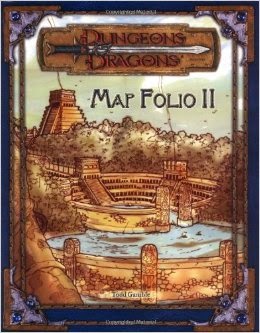
Must have been at least eight years ago, I picked up WOTC’s Map Folio II for some reason. It’s a series of maps that (apparently) originally appeared on their website, and depict a city in the Mesoamerican-based Maztica kingdom. I’ve never used it.

Map Folio II. I loaned it out without taking pictures first.
I showed it to my friend Grant the other day, and he wants to stock it and run it. I told him I’d post some stuff I thought he could use. There’s already these two posts if he hasn’t read them yet, and a lot of really detailed articles at Saurondor.

Grant told me that he’s thinking of this city as a thriving metropolis, which makes stocking it a fundamentally different exercise than if we were talking about a decrepit ruin. The first part of the job, as I see it, is to look closely at what the maps can tell us about the people living there, and the second part is to figure out what the hell to do with that. This is probably going to have to stretch across a few posts. I don’t have the map set in front of me since my friend’s borrowing it, but I’ll see what I can come up with from memory.

The city is a highly planned settlement that looks as if it would probably have been built pretty much all at once, in the shape of a vast amphitheater. The individual maps include a watchtower, a temple, an observatory, a forge or smelter, and a palace, as well as examples of upper, middle,* and lower class neighborhoods. Right off the bat, the forge tells us that this civilization is using technology that real-life Aztecs and Maya didn’t have access to when they were building cities. Similarly, the lower class apartments imply that society has been restructured around this technology. That statement might require some explanation.

Not from the Map Folio.
Look at the Aztec capital of Tenochtitlan. The elite, which consisted of warriors, priests, and royalty, was centrally located, while the rest of the poor schmucks were spread out in blocks of floating gardens that fed the city. In contrast, the city in the map pack has replaced this agrarian economy with an at least semi-industrialized one. Poor folks aren’t spread out and living on the small farms where they work, they’re living in small, tightly packed apartments, presumably because they all work at the same place — the forge.

One way to explain all this is with a brief alternate history exercise. In this version, when European murderhobos like Cortez and Columbus got to the continent, the native kingdoms recognized the apocalyptic danger they were in, and united against them. In real history, Cortez probably would have gotten his heart cut out and thrown onto the sacrificial fire, if he hadn’t formed alliances with the surrounding kingdoms to bolster his tiny and poorly disciplined** invasion force.

If the Spanish conquest fails, then Aztec influence spreads (due to the alliances that kept them alive) and Montezuma II orders that the secrets of steel and black powder are mastered before the next wave of white devils hits the New World, whether by analyzing the equipment of dead conquistadors, interrogating the shit out of the many European captives they’d have taken, or a combination of both. This city was built after that, and is likely the youngest city-state in the empire. It’s most likely to be located at or near a major iron deposit. If that iron deposit was caused by a massive meteorite falling to Earth millions of years ago, then the impact crater explains the shape of the city as a whole.***

So that’s the boring stuff out of the way. This is going to have to be a series. Later posts will be about setting-specific factions and monsters, interesting treasures, and a super-narrow discussion of Mesoamerican religion. Plus anything else I think of.

*This living space also includes shops in front of the apartments, like the tabernae in Trajan’s Market. The general layout of the city was probably pretty closely based on that ancient shopping mall. Do anthropologists know more about how Romans lived than Aztecs, or was there some other reason for the artist to mix the cultures?

Trajan's Market
**The incident that sparked war between the Aztecs and the Spanish (in real history) occurred when Cortez had to leave some of his men in Tenochtitlan under orders to play it fucking cool. As soon as they saw their first human sacrifice, they went totally apeshit and started shooting and stabbing. Also, there was also at least one of his followers (Cristobal de Olid) who, when entrusted with his own command position, went all Colonel Kurtz and tried to set himself up as a king. Cortez himself went to put down the rebellion, but Olid's own men had already done the job.

***Mesoamerican city builders (or at least the Aztecs, Maya, and Inca) were all about reflecting the landscape surrounding a city in its architecture, and allowing the natural and the man-made to coexist harmoniously. I wonder if that’s where Frank Lloyd Wright got the idea. Anyway, many of the Roman-influenced aspects of the city’s plan make more sense if you think of it as being sort of built onto the slopes of a gigantic impact crater.


OH SHIT WHAT ABOUT THE JOESKY TAX

Here's a map of a cenote cave system. If you don't know what that means you really should google it. Maybe I'll decide what's in it tomorrow.


Thursday, December 25, 2014

Nothing Says Christmas like Rules for Malaria

If you use nothing but the information and tables in any of the core D&D rulebooks, I’m pretty sure the only thing that really differentiates jungle regions from other types of terrain is the wandering encounter tables. There might be something about how long it takes to travel through the area, or how easy it is to get lost there like in Barbarian Prince/Road of Kings, but that doesn't seem like enough. It seems to me that the jungle itself should be just as much of a challenge as the stuff you encounter there, or you’re missing an opportunity.

You could (and probably should) treat the jungle as a dungeon in and of itself. I probably wouldn’t go so far as stocking a complete subhex breakdown, but creating a point crawl for each hex (not as detailed as that one though) really isn’t that bad as far as prep goes. 
A tile from an old board game called magic realm.
Old-school versions of the DM Guide always made it a point to tell DMs what ratio of rooms with monsters to rooms with treasure (for example) they should be going for. This table is the same thing as that, but for nodes instead of rooms:

1d6 JUNGLE NODE CONTENTS
1 Nothing Unusual
2 Encounter
3 Encounter & Treasure
4 Terrain Feature 
5 Terrain Feature & Encounter
6 Terrain Feature, Encounter & Treasure

I tried to keep most of the following rules and information as general-purpose as possible, which is my excuse for not including encounter tables in this post. That said, I’m writing this so I can use it in the Yucatan Peninsula, and a few details are going to be specific to that region. You can always change them if you want.

This table lists a few of the major terrain features that your players could come across. There should be fairly obvious ways to interact with all of them.

D12 JUNGLE TERRAIN FEATURES
Quicksand - Starting at the beginning of the party's marching order, everyone saves until someone fails and falls waist deep into the pit. Every 10 second round, that person sinks another 1d10 inches (shit I may have to put a blank spot for height on my character sheet). People wearing heavy armor sink 2d10 inches per round. Pulling the character out with rope requires a strength check, more than one person pulling grants advantage on the check.
2 Banana Grove - If you can climb a tree, you can get as much food as you can carry. It goes bad in 1d8 days. 1/6 chance of an anaconda lying in wait. Otherwise, there are 3d12 howler monkeys hanging out that will probably attract attention.
3 Running Water - Secretly check for piranhas (1/6) and also roll 1d4 on this table.
  1 Stream - Only a couple feet deep and 1d10+20’ wide. 
  2 River - 1d10+10’ deep, 1d20+30’ wide, swimming check or end up downstream.
  3 Rapids - Large (and slippery) rocks sticking out of the water all the way across, skill checks/saving throws to cross without falling in and ending up downstream (no swim check).
  4 Waterfall - Same as Rapids, plus Cliff.
4 Blasted Clearing - No trees here, just blackened stumps, but that means the undergrowth is getting crazy amounts of sunlight. Any attempts to find useful (or dangerous) herbs in this area get advantage.
5 Cliff - If this node has more than one approach, decide whether someone traveling from each direction would be at the top or bottom of the cliff and mark it on the map. Any combatants at the top of the cliff would have an obvious tactical advantage. Moving up or down the cliff requires a successful climb check.
6 Cave - Oh come on. If you can’t think of something fun to do with a cave then you need to let someone else DM.
7 Ancient Trees - A thousand years old and a hundred feet tall and a dozen feet in diameter. Climbing these trees requires specialized equipment and takes time, but allows you to see major features four hexes away. Wildlife encounters are common at the top.
8 Ridgeline - Can see major features two hexes away from the highest point.
9 Ravine - Double random encounter chance in this area, probably an ambush.
10 Cenote - Deep and wide natural limestone pits with freshwater pools at the bottom. There’s a 1/3 chance that a village has formed around the cenote.
View from inside Ik Kil, a cenote near Chichen Itza
11 Recent Battleground - Broken and rusted weapons and armor half-buried in the bloodstained mud. At least two separate mass graves, the occupants of which may or may not A) be buried with valuable trinkets and B) be undead.
12 Overgrown Ruins - Site of an ancient city. Roll 1d4, 1d3 times, to see what’s left of it (and accessible). Only one palace should be here but there could be multiple temples and tombs.
  1 Palace
  2-3 Temple
  4 Tomb 

Roll on the appropriate weather table for the season at the start of each day. Rainfall typically occurs in the late afternoon and lasts 1d12*30 minutes. The only two seasons are wet and dry.

Temperature is in the 70s - 80s (fahrenheit) range year round, with a crazy amount of humidity during the wet season.

D6 WET SEASON (June—October) JUNGLE WEATHER
1 Dry Today - +1 chance of random encounters for 24 hours starting at dusk.
2 Light Misty Refreshing Rain - Heal 1d4 hit points during rainfall, even if traveling. This type of rainfall doesn’t heal you during combat, but will afterwards if the rain doesn’t stop first.
3 Big Ol’ Fat Rain - Non-natives suffer a -15’ movement penalty during rainfall and a -5’ penalty for the next 24 hours.
4 Torrential Downpour - Non-natives suffer a -30’ penalty and a -10’ penalty for the next 24 hours. Natives treat this like non-natives treat Big Ol’ Fat Rain.
5 Lightning Storm - 1d12 chance that the storm is focused on your current hex, in which case trees near the party keep getting struck by lightning and exploding, sending grenade-like shrapnel off in every direction. Save or take 1d6 damage. This happens right next to you every 1d10 minutes until you get out of the hex.
6 Hurricane - Torrential Downpour for 24 hours before the hurricane, which lasts 1d4+2 hours with a 1d6*10 minute period of complete calm in the middle, and again for 24 hours after the hurricane.
During the main storm, anyone without shelter must make two saves every hour; one reflex save to avoid flying debris, and a fortitude save against exposure to the elements. Failing either save means that a character is incapacitated, and will suffer 1d4-2 (minimum 1) points of damage for the remainder of the storm (including the Torrential Downpour) unless rescued (which might be even worse, depending on who finds you).
Even if you do find shelter, it should take damage during the storm, though you’d get a chance to make some quick repairs during the calm. I’m comfortable waiting until it comes up in play to figure out exactly how that works.

D20 DRY SEASON (November-April) JUNGLE WEATHER 
1-16 Dry Today
17 Light Misty Refreshing Rain
18 Big Ol’ Fat Rain
19 Torrential Downpour
20 Lightning Storm

JUNGLE SURVIVAL RULES
-Natives get to ignore this whole section.
-You need to drink twice as much water as usual. Three times as much during the wet season.
-Roll a navigation check to make it from one node to the next. If you fail, you find yourself walking in circles and basically spend another turn in your current node. (This is straight out of Barbarian Prince).
-Even if you don't get lost, it takes twice as long as usual to travel.
-Every day, each character has a 1% chance to have to roll a successful saving throw or come down with malaria.

MALARIA
-Symptoms appear for 1d4+2 hours at a time every 24 hours, and basically make you bed-ridden, shitting and vomiting out everything in your system.
-You can’t survive a malaria flare-up without either A) some sort of medical attention or B) very very careful preparation (shitload of water, safe space, a few buckets, etc. Think about the detox prep scene in Trainspotting).


-Save every day, or your condition worsens, now affecting you 24/7. If you fail your daily save while your symptoms are already active all day every day, your condition doesn’t immediately worsen further, but if you fail three days in a row in that condition, you fucking die and need to roll up a new character.
-If you make your daily save three times in a row, you beat the infection. All symptoms disappear and you are now immune to malaria, for the duration of the campaign at least. Thank fuck.
-A cure disease spell would work but wouldn't give you a future immunity.