Showing posts with label keyed encounters. Show all posts

Monday, December 22, 2014

Carcosa: Psychic Cyborg Sorcerer (of Slaughter)

I owe back taxes to Joesky so here is a Carcosa for you.

This adventure is intended for levels one through ten or something like that. There are monsters here that would pummel most level seven parties. That said, I’m pretty sure it’s possible for level one characters to kill everything in this hex if they really apply themselves.

There are two deserts on the map in the Carcosa book. Pick a hex in one of them, and put this stuff there. If you have the book, you know that each hex has two briefly described features. It shouldn’t be too hard to add them in to make this mess even weirder.

Roll random encounter checks (1/6 chance) every 90 minutes in this hex. Descriptions, stats, and reaction tables for the monsters are at the end of this post.
1 2d4 blue people riding mutant protoceratopses (shield lizards)
2 3d6 green people hunting with long spears
3 mutant apex dinosaur (great tooth)
4 psychic cyborg sorcerer of slaughter
5 3d12 wild shield lizards
6 2d4+2 mutant tetrapterix (cliff birds)
7 spawn of shub-niggurath
8 acid bug


TERRAIN
This hex is riddled with the maze-like sandstone cliffs of a technicolor desert. Small clumps of spiny bushes appear every so often, but most have been stripped clean by shield lizards. Every 12 hours, there is a 1/8 chance of a sandstorm picking up that is fierce enough to force the PCs to find shelter or take 1 die of damage per 10-minute round. These storms last 1d8+2 rounds. In addition, PCs must consume double the normal amount of water and food rations due to the harsh climate.

The connections on this node map take three hours to travel on foot (so two encounter checks). Instead of forcing players to map out and navigate some contrived and irritating maze, make them roll an intelligence check to not get lost whenever they try to move from one node to another, unless they’re following a guide. If they fail, they find themselves traveling in circles, traveling for 1d12 10-minute rounds and finding themselves back where they started.

Using a highly detailed map grants advantage to navigation checks. Nothing is stopping the PCs from saying “we take the time to carefully map the canyons as we explore” so that retracing their steps is easier.

ACID BUG CAVE
I would start the PCs off here, where they are railroaded forced to seek shelter from a fierce sandstorm in a deep cave with a tight entrance, too small for any of the local dinosaurs to have gotten into. There is, however, a man-sized acid-spitting centipede living in here, which gets a surprise round unless someone passes an awareness check. The centipede’s acid glands can be harvested to fill 2 standard oil-or-potion sized glass jars.

In the corner of the cave, they find a human looking figure half buried in the sand. If they approach it for a closer look, they see that it’s a long-dead space alien. All that’s left of it is a skeleton and gauntlet (treat as small shield) that has a screen and a switch on the left forearm. If the switch is pressed, the screen activates, pointing the way to the alien’s nearby ship. If anyone can actually read the space aliens’ language, they know exactly what this is. Otherwise they just know it’s a topographical map of the area, centered on their current location, with a blinking beacon to the northwest. The sandstorm dies down after 1d6+2 10-minute turns.

CRATER
The spaceship is located in the middle of a fairly large crater (which is old enough to have some sparse vegetation), and appears to have been badly damaged and partially repaired. The cargo bay door is open. All the interior doors are closed but can be opened with a successful strength check, with advantage if using something like a crowbar. This makes a lot of noise, which will alert the psychic cyborg sorcerer to the PCs’ presence if it’s currently in the ship (a 2/3 chance).


The armory contains six grenades (3 dice of damage) and four high powered laser rifles (2 dice of damage), as well as ten napalm canisters for the cyborg’s flamethrower arm and sixteen power cells for the rifles. The rifles need to be loaded with a power cell to function, and each cell has 50 charges.

In the robotics lab, the PCs find a whole mess of mad scientist style notes, from which they can learn that: 

1) The psychic cyborg sorcerer found a damaged robot in the crashed ship, which he repaired and into which he transplanted his brain. He’s been using the torch and advanced strength of his new body to repair the ship.
2) He knows the conjuration ritual for the Violet Mist, but won’t perform it until he learns the ritual to bind the creature.
3) That binding ritual is inscribed on a tablet that is probably in a serpent-man temple a week’s march away. 
4) That temple is currently inhabited by cannibal bone men that exact tribute (as in people to eat) from all the nearby human groups through force of arms.
5) All of the structural repairs to the ship are complete, at this point it’s just the engine left, which should take about four weeks to fix. The notes are complete enough that only an intelligence check with advantage would be necessary if the PCs wanted to finish fixing it.
6) The sorcerer has a serious grudge against any leader of men you as the DM want, either an original one or any of the ones described in the hex crawl, and would not hesitate to wipe out that man’s entire settlement for the sake of vengeance.

GREEN CAVE
A settlement of 200 green people live in another cave in the cliffs, hiding from the local predators and hunting the smaller dinosaurs. They usually arm themselves with long stone-tipped spears, slings, and stone axes, but their leader and his two lieutenants have acquired red laser pistols (1 die of damage, d100 charges). They aren’t actively at war with the nomadic blues that have set up camp nearby, but they live in a state of mutual distrust. Every week there is a 1/6 chance of the greens performing an elaborate ritual (not the powerful kind that sorcerers perform, more like church) in which they sacrifice a group of 1d12+6 captives to the spawn in the oasis.

There is a completely dark chamber at the back of the caves, the walls of which are covered in cave paintings. The paintings’ subjects include the alien shipwreck as an event, the local dinosaurs interacting with the greens, the spawn of shub-niggurath rising from its lake to accept a blue man sacrifice from green worshippers, and battles between the greens and peoples of various other colors.

Another chamber in the cave system contains dozens of crude candles and well-polished fertility figures carved from precious stone, with a large mat of leaves and feathers covering most of the floor.

BLUE CAMP
The nomadic blue people are a bit more advanced than the nearby greens. They’ve learned to tame the shield lizards and use them as mounts and beasts of burden. Their hunters and war parties are usually armed with short bows and iron axes, wearing leather armor and shields made from deceased shield lizards. Their tents are similarly made from shield-lizard hide and bones. The leader of the blue nomads is armed with a sonic bazooka (3 dice + save or unconscious for 10-30 minutes, 25 charges).

This group of blue men likes to collect hollow objects of all shapes and sizes, and use them as percussive instruments in elaborate drum-circle dance rituals.

Unless something unexpected and probably terrible happens, this small tribe of about 60 will stay in the area for 1d6+3 weeks. Every week, there is a 1/6 chance of all-out war breaking out between the nomadic blues and the cave-dwelling greens.

The connection marked ‘narrow path’ protects them from the nearby apex dinosaur, which would have to squeeze through, making it vulnerable to attack.

LOTUS BUSH
Roll a d6 to determine the color of lotus using the description in Carcosa as a table. There are 2d6 harvestable doses of that here. That’s all. Move along. Well I guess you could be a dick and put a radioactive mutant snake or something in the bush, hiding. Actually yeah do that.
HD: 1/2 AC: as unarmored
Attack: bite (1 die of damage + poison (save to resist) + radiation sickness (save to resist))
Move: 20’

GREAT TOOTH CAVE
There is a large bone pile in the corner of the cave. If the PCs search it, they find a magic chain whip forged by serpentmen among some human bones. It has a ten foot reach and gives its wielder a +6 bonus to any attacks that attempt to disarm or otherwise disable their target rather than cause HP damage. It would have been useful when the serpentmen were capturing humans alive for sacrifice.


CLIFF BIRD NEST
Halfway up the cliff (about 40’ above the ground), there is a very large outcropping covered by clumps of thick, dead bushes and brambles. There are 2d12 cliff birds up here at any given time, as well as 3d4 eggs the size of pineapples.

OASIS
The amphibious spawn of shub-niggurath lives in a large cave hidden near the bottom of this quarter-mile wide and half-mile deep freshwater oasis. Anytime you or anything else approaches the waters’ edge, there’s a 1/12 chance that the spawn will attack.

MONSTERS
Acid Bug - A centipede the size of an adult human, and it spits acid. Sickly white coloring.
HD: 2  |  AC: as chain
Attacks: acid spit (2 dice of damage)
Reactions: ambush (2-12)

Cliff Bird - A brightly feathered tetrapterix-like creature the size of a large dog. They like to climb the cliffs and attack silently from above. Passing an awareness check means you see their shadow and there’s no surprise round.
HD: 1  |  AC: as unarmored 
Attacks: 2 claws (1 die) + beak (1 die)
Move: 40’ land, 250’ air
Reactions: ambush (2-6), stalk and wait for opportunity (7-10), intimidated (11-12)

Great Tooth - Like an allosaurus with a tail like an ankylosaurus and flashy neck frills like the dinosaur that ate Newman in Jurassic Park. About the size of a bus. Always hungry. The PCs can hear it coming from a quarter mile away, but it can also smell them at that distance. It only sees light and movement.
HD: 12  |  AC: as leather
Attacks: charge (8 dice) or gore (2 dice) + bite (2 dice) + tail (1 die)
Move: 80’
Reactions: try to eat you (2-11), brief confusion before trying to eat you(12)


Psychic Cyborg Sorcerer of Slaughter - A ten-foot tall humanoid robot with a thick glass dome at the top of its head, protecting a sorcerer’s undead brain. One of the robots’ arms ends in a human-like hand and the other is mounted with a flamethrower, which also has a setting that converts its napalm fuel into a gas suitable for welding. It’s been using this to repair the dead alien’s spaceship.
HD: 14  |  AC: as full plate
Attacks: incinerate (4 dice) or punch (2 dice)
Move: 30’
Psionics: as 9th level psionic (pgs 18-21)
Reactions: exterminate (2-7), try to recruit you (8-11), lets you go free (12)

Shield Lizard - Like a protoceratops the size of a car, with spikes all around the edge of its face shield and a sharp beak.
HD: 6  |  AC: as leather w/tower shield
Attacks:bite (1 die), charge (4 dice), or trample (6 dice).
Reactions (wild): charge (2-7), ignores you (8-10), curious but tentative (11-12)

Spawn of Shub-Niggurath - About the size of a tenement building, this spawn has a body type basically like that of a fur-covered caterpillar, with four giant bat-like wings that beat with the speed of a hummingbird while it’s flying, two compound eyes, a simple insectoid mouth from which it spits webbing, and a long, whiplike tail.
HD: 10  |  AC: as unarmored
Attacks: tail whip (4 dice) + spit (no damage, target is stuck (save to avoid), strength check or fire (which also burns you) to escape)
Move: 25’ flying, 10’ land, 80’ underwater

Reactions: try to eat you (2-7), not hungry, but webs you out of spite (8-10), ignores you (11-12)

Friday, November 7, 2014

History is just really old rumors

There is a wide, hexagonal altar of some kind in the center of this room, with six outer panels, and one upwards-facing middle panel. One panel has a slot on the left side that looks like it's the right size to insert one of those shiny discs you found elsewhere in the ruins.

Once you insert a disc, the middle panel of the altar lights up as the rest of the room seems to go dark. Moving images that look as solid as the altar itself appear in the air above the panel, and you hear a voice with an unfamiliar accent in your head. With accompanying imagery, the voice tells you three things before the altar breaks apart in a flash of sparks and a cloud of smoke.

1) The beings that designed this place referred to themselves as the ascended. They grew servitors in thick glass vats, in the image of their own primitive ancestry.

2) The Ascended Age followed the Heroic Age, which began with the Time War that ended a thousand years of darkness and enslavement to beings from another world.

3) The ascended created a worldwide awareness dampening system, which hides the entrances to their underground structures from the notice of most non-ascended humanoids. Consequentially, no record of them exists on the surface, and only a few secretive explorers have even heard of the species.

4) Hybrid animals of every description were created both to perform specialized tasks and for the ascended's amusement. Many have special abilities, and most are at least as intelligent as a human child.

5) The worm is another creation of the ascended, who once used it for instant worldwide communication. It's still capable of this, even though it hasn't been activated in centuries.

6) The worm has been here since the beginning. It guided the initial evolution of early humans and has been monitoring divergent and convergent cultural patterns since then. As a result, the worm knows about pretty much everything that's ever occurred on the planet. 

7) The history of the modern world parallels that of the Innocent Era, before the Dark Millennium. This is the result of interference by the ascended and/or the worm, and humanity can only be made free through the destruction of its secret puppeteers.

8) The Future Gods, heroes of the Time War, were the greatest champions that humanity has ever seen. Unfortunately, they were feared tyrants in the peace that followed. They were slain and entombed at the center of the Earth, reflecting both the honor and the terror that they inspired.

9) The beginning of the Ascended Age was marked by the development of the Lazarus Serum, which granted immortality to those deemed worthy by the creators of the serum. The ascended migrated underground, while those deemed useless were left to struggle on the surface. These eventually evolved into the various humanoid species known today.

10) The "Lazarus Serum" was a genome that was introduced to the entire human race. Unlimited lifespans allowed great thinkers to discover entirely new fields of science, while pushing development in existing fields to the point of convergence. The personal libraries of ascended researchers contain esoteric knowledge centuries beyond that of modern humans.

11) The worldwide Servitor Rebellion was the end of ascended civilization. The surviving ascended formed secretive island enclaves and are now known as high elves.

12) All of the ascended are long dead and all humanoid races are the descendants of the servitors.

13) Humanoids evolved from servitors while the ascended fled underground to escape the rebellion. They are waiting until their population recovers to reclaim the surface world.

14) Many devices of impressive power first appeared during the Heroic Age. Rings that grant their bearers unimaginable speed or control over light made solid, suits of armor that made humans into flying juggernauts, and weapons with powers as varied as their physical forms.

15) Although there is evidence that some forms of primitive shamanic magic was practiced during the Innocent Era, magic's essential nature was not seriously studied or understood until the Ascended Age. That primitive magic often resulted in demonic entities that probably still exist deep underground.

16) The Space Gods that enslaved humanity during the Dark Millennium were unaware of the existence of worlds other than their own until it was discovered by human explorers. The vessel used by these explorers was launched from a secret underground base that the Space Gods never learned of.

17) The Space Gods were aware of human development throughout the Innocent Era, while they watched and waited for their ancient prison to deteriorate. No one knows who or what built their prison, but their magic and/or technology must have been impressive indeed.

18) The supply of the elements used to create the Lazarus Serum was extremely limited. Another war broke out when those deemed less than worthy attempted to take it by force. This conflict made the planet's surface uninhabitable by humans and ascended alike for centuries, though severely mutated versions of many species were able to adapt and survive.

19) During the Dark Millennium, the Space Gods maintained strict control over human reproduction, and harvested energy from human bodies for sustenance. Some of the factories where this occurred are believed to still exist deep underground.

20) The Dark Millennium saw the construction of hundreds of temples and artifacts by human slaves, for the purpose of eventually summoning the beings that were worshipped by humanity's Space God masters.

Sunday, October 26, 2014

Kellerlabyrinth Keyed (basically)

Decided to partially stock my Kellerlabyrinth segment. "Partially" because this is one of those partly-ruined/partly-still-in-use dungeons where it makes sense to try and get across a largely abandoned feeling.

First, some history to give this stuff some context. According to the adventure background in Better Than Any Man, it takes place in October 1631. Wurzburg falls to the Swedish on October 15.

Before the war started, Oppenheim was under the jurisdiction of the (protestant) Count Palatine. The Spanish Hapsburgs (in an alliance with the Austrian Hapsburgs a.k.a. the Holy Roman Empire) took the city in 1620. The (protestant) Swedish army took Oppenheim on November 7 on its way from Wurzburg to Mainz; 23 days after the Bishop of Wurzburg surrendered.

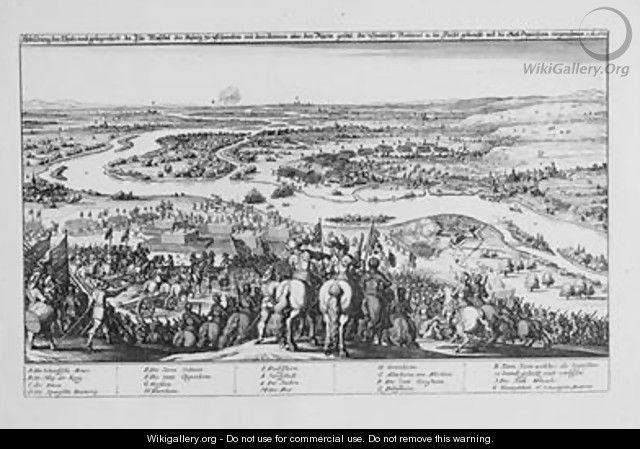
While the Spanish had control of the city, they were using it to store weapons and ammo, and for access to an important bridge, which in turn gave them access to the entire Palatinate. In the image below, the six-pointed star shape next to the river is the wall surrounding Oppenheim. Those blocky shapes to the left of it are probably Swedish mixed unit formations of musketeers and pikeman (the taller, lighter blocks are pikes being held at shoulder arms). Don't ask me where the bridge is; it might be too small to see in the distance if it's right by the city but I really couldn't say for sure.
Artist: Matthaus the Elder Marien
So, to summarize from the DM's point of view: the campaign begins with BTAM at the beginning of October 1631. Wurzburg falls on October 15. The trip to Oppenheim* takes between a day and a half and a week, depending on how much crap the PCs are lugging around and whether or not they've managed to steal some horses. Assuming they arrive by November 7, the (catholic) Spanish are in control of the city until then. Some of the occupiers will be preparing to offer token resistance, while others will be taking their troops and heading north to Mainz, where the real siege is gonna go down.

After November 7, the (protestant) Swedes are in charge. The changes that matter to PCs will mostly be cosmetic (government officials have Swedish or German names instead of Spanish ones), but protestant civilians will be likely to start treating them like heroes if they helped liberate the city in a significant way.

*Yeah okay this part is totally railroading the game if you aren't prepared to improvise a little, so here's the obvious disclaimer: The PCs are of course free to keep fucking around near Wurzburg and Karlstadt or go wander around Germany or whatever, but tell the players that there's cool stuff under Oppenheim and maybe they won't be lame about it. If they do get distracted or something, there's nothing wrong with taking elements of this and putting them elsewhere; I'm assuming you've done this before if you are going to try and run this adventure location, so you probably know what to do.

I haven't assigned these encounters to any particular spot on the map so just number the rooms however you want. Assume that any humans without hit dice or levels listed are untrained peasants.


1) Munitions Storage
Door: Medium quality lock on a wrought iron gate. 2 3HD Spanish Soldiers are posted outside, wearing morions and breastplates, armed with pikes and flintlock pistols.
Contents: Full of weapons. If you want pistols, muskets, pikes, swords, shot, or gunpowder, this is the place to get it. I'm not worried about how much stuff there is to take away because I generally keep track of time and encumbrance; even if they make multiple trips, the PCs won't run out of stuff to cart off before the next guard shift shows up. Let's say there's enough in here to arm one unit (regiment I think? I'm not up to speed on 17th century military jargon) each of musketmen, pikemen, and cavalry.

2) The Meeting Place
Door: Medium quality lock. If there is a meeting underway,
Occupants: If there's no meeting happening, there's no one here. Assuming the meeting is in progress, there are 6 Mysterious Figures in the room, wearing identical hooded cloaks that hide all identifying features. They know the Swedes are on their way, and have developed a plan to blow up several Hapsburg weapon caches, but lack the skills to pull it off. One or two are wealthy merchants that can afford to pay the PCs pretty well. If the PCs don't accept this mission, the resistance finds someone else, so the Swedish attack is still successful. If the PCs kill the resistance members, there's no good reason there wouldn't be more spies the PCs don't know about.

3) Jaspar's Treasure Cache
Door: Heavy oak door, high quality lock, poison needle trap triggered by attempting to pick the lock. Attempting to force the door has a 1/4 chance of causing the tunnel to collapse (in addition to the usual wandering monster check). There are two keys to this door; one belongs to an officer named Jaspar Hardtman and the other belongs to his manservant, Symon Dreyer.
Contents: 6 chests containing 230 gp, 1250 sp, and assorted gems and jewelry worth 150 sp.

4) Cursed Statue
Door: Heavy oak door, high quality lock, poison needle trap triggered by attempting to pick the lock. Attempting to force the door has a 1/4 chance of causing the tunnel to collapse (in addition to the usual wandering monster check). The key belongs to someone but I'm not saying who.
Contents: A fine layer of dust over everything, an old desk with a leather-bound journal describing a merchant's expeditions to the Indian Subcontinent and a map showing the location of Petra (stumbled upon while fleeing Bedouin raiders on a return trip), a painted ebony statue of Kali the Destroyer that comes to life and fucks you right the fuck up if you enter without using the key. Not bothering with stats here; let's just say I don't expect the party to live if they try to fight. If they do beat it, the statue crumbles; the resulting pile of debris takes up 10 inventory slots and is worth around 80 sp.

5) Kruper's Hideout
Occupants: Velten Kruper, a level 4 mage, armed with a flail. Erbrechen (translation: the act of vomiting), Kruper's disgusting little homunculus familiar, unarmed but his bite causes (on a failed save) uncontrollable nausea that lasts 1d4 rounds AND it does 1 point of temporary CON damage that heals when the victim eats a meal and rests. Kruper is either asleep or tinkering with his equipment or spellbook, which contains 4 level one spells and 3 level two spells, in addition to one custom spell:
Crawling Eye (Level 1): At the end of the incantation, the caster pops out one of his or her eyeballs, along with several inches of optic nerve, and tosses it to the ground. The optic nerve splits into three legs and becomes mobile. The eye is controlled (and transmits information) through direct psychic contact, which doesn't distract the magic user from whatever else he's trying to do (although anything involving depth perception should be rolled at a disadvantage). The eye can move as quickly as an unencumbered human, is extremely sneaky and hard to hit due to its size, and has one hit point. If your eye is destroyed, you don't get it back (One-Eyed Velten has a nice ring to it now that I think about it). If you lose both eyes you basically have to invent and translate your spellbook into braille if you want to ever use it again.

Contents: Bed, foot locker with a change of clothes and some rations, table & chair, alchemy equipment, box of candles, silver candelabra worth 50 sp, leather purse containing 80 sp.

6) Refugee Camp
Occupants: 1d6+4 Peasants, 1d4 of whom are children. The refugees are shaken down for what little they can scrape together on a weekly basis by Bardthold's gang.
Contents: Straw mats, sacks containing basic goods, a couple farming implements that could be used as weapons in a pinch, torches in holders.

7) Bardthold's Hideout
Occupants: Barthold Vischer, level 5 fighter with a scarred left cheek, wields a 10' long hooked chain that can be used to attack, trip, disarm, or grapple, ring mail armor, iron key, wineskin. 2 2HD Bodyguards, leather armor, pike, 1d30 sp each, no morale failure. 3d6 1HD Thugs, club or dagger, 1d12 cp each.
Contents: two dozen straw mats and blankets, locked chest containing 3500 cp, 350 sp, and a silver locket with a broken chain, containing the portrait of a young officer, worth 20 sp to a merchant or 300 sp to his mistress, torches in holders.

8) Guarded Cache
Occupants: 1 2HD Veteran and  2 1HD Guards, leather armor, shortswords, shields, writ of employment, 1d12 sp each. 2 2HD Wardogs.
Contents: Three straw mats, two iron-bound chests with very high quality locks. One is trapped with a glass vial of poison gas that expands to fill the room, and the other contains 650 sp and 320 gp.

9) Rat's Nest
Occupants: 1d4+2 1HD Giant Rats, Rat Swarm.
Contents: rat feces, broken and rotted crates full of spoiled goods, a weird orange mold that the rats have been eating.

10) Locked Storeroom
Door: Average quality lock, reinforced with wrought iron bands. The key belongs either to Olga Bruns in room 15, or to one of the surface innkeepers.
Contents: 6 kegs of beer, 3 casks of wine, crates full of pickled vegetables and salted meats wrapped in wax paper.

11) Forgotten Storeroom
Door: Old, faded wood, high quality lock, rusted and brittle hinges.
Contents: Thick layer of dust over everything. A bunch of old, broken junk, and a child-sized skeleton locked in a cage in the corner. The skull has a third eye socket in the middle of its forehead.

12) Shrine to The Four Holy Marshals
Contents: Wooden altar, wooden statues of four saints (one against each wall), with the name of the subject conveniently carved into each base. All five objects have been down here in the damp air for around a hundred years and are partially covered in grey moss (useful for healing potions).

13) Plague Quarantine
Occupants: 1d4+7 plague victims. Sister Anneke Everding is tending them, which she sees as a holy sacrifice as she is sure to become infected soon.

14) Opium Den
Occupants: Zheng Wulian, the face of the operation, level 3 rogue, extremely gifted with languages, armed with two flintlock pistols and a sword, wearing a large emerald ring4 3HD Guards, barechested and scarred veterans that came here from China with Zheng, each armed with two maces and a dagger. 1d8 Semi-Conscious Peasants. 1/4 chance of a Usual Suspect.**
Contents: A dozen cheap, straw-stuffed mattresses, 4 long-stemmed ivory pipes carved like oriental dragons, a locked wooden chest containing 2000 cp and 500 sp, a large brass urn containing let's say a pound of opium, 4 large brass lamps in the arabic style.

15) Drinking Hall
Occupants: Olga Bruns, runs the place. 1d8 Peasants1d2+1 1HD Thugs1d4-1 Usual Suspects.**
Contents: Puddle of vomit, tables, benches, tin mugs, 4 large kegs of beer and 2 large casks of wine in an alcove, iron chandelier, box of candles, chest containing 450 cp and 80 sp.

Okay so the map I drew has about twice as many rooms as I've detailed here. You can stock the rest with the following table, using the details in similar rooms that I've already described as a guide:
1) Refugee Camp
2) Waste Room (full of filth and garbage, will eventually be sealed off)
3) Locked Storeroom
4) Munitions Storage
5) Looted Storeroom
6) Looted Storeroom
7) Forgotten Storeroom
8) Forgotten Storeroom

Random Encounters
1) Rat Swarm, 1/4 chance that they are plague carriers.
2) A Black Cat, that is almost certainly a transformed witch, crosses your path.
3) 1d6+1 Wild Dogs, if there are three or less present then they have rabies.
4) 1d4+2 1HP Giant Centipedes, about a foot long, paralytic bite.
5) 1d6+2 Thugs, clubs and knives, 1d12 cp each.
6) Velten Kruper's Crawling Eye.
7) A Usual Suspect.**
8) Plague Victim, has gone mad and escaped the quarantine.
9) Ghost of St. Quirin
10) Ghost of St. Hubert
11) Ghost of St. Cornelius
12) Ghost of St. Antony
All four of the ghosts have the power to bless or curse PCs (maybe I'll do the specific effects in a later post but this is already way longer than I thought it would be). They are all-knowing within the confines of the Kellerlabyrinth, and decide what to do with you based on your actions on what they see as their turf.

**Usual Suspects 
1) Hernando Perez, inquisitor, level 3 fighter, suspects everyone including PCs of witchcraft, will pay handsomely for magic users or information leading to their capture, armed with a flintlock pistol, a rapier, and a stiletto.
2) Sly Ludolf, hustler, level 4 rogue,  prefers three card monte so get practicing, DM. Or if you are an irretrievable klutz, he uses loaded dice (before the game, pick a couple and melt them VERY slightly in your oven with the number you want most often facing up). A leather purse contains 2d30 cp. Carries a rusted shortsword.
3) Hermann Clump, ratcatcher, talks to them, is friends with them, is defensive of them, can summon a swarm of them to protect him in combat, eats them (they don't mind because they have tiny easily manipulated rat brains). Keeps a couple rats hidden in his clothing when in public areas. They tend to run around in there, which is inconvenient, because Hermann is a bit ticklish. Armed with a big-ass meat cleaver that counts as a battle axe. Treasure: cheese, moldy cheese that makes you either hallucinate or completely understand the universe (it's impossible to tell which for sure).
4) Ilsabei Muller, super protective mother, never seen without her 8 year old son, Erich. The second time you meet this pair, Erich's eyes have grown noticeably darker, and his voice and mannerisms have changed in an ominous sort of way. Ilsabei hasn't noticed, and even if you point it out to her, she's likely to chalk it up to puberty. If you point out that Erich is probably a bit young for that, she'll claim this is due to his "exceptional qualities." There will be no reasoning. They're both unarmed but who the hell knows what Erich's capable of.
5) Maren Domeier, musician, carries a mandolin, only plays her own songs. These are somewhat nonsensical ditties about life in the tunnels, which occasionally yield useful information to any careful listeners in the audience.
6) Masked Woman, no one else seems to be taking any notice of her, but she's staring at you and she hasn't blinked once. Her sword and cloak look just as expensive as her ceramic mask, which is shaped like a stylized owl.